I have no problem with people who are vegetarians (or even vegans) but I do have a real problem with arguments like this one that, effectively, call all meat eaters horrible people.
Yes, most livestock in this country is poorly treated, and we should stop that, and yes the reasoning is perfectly legitimate, but the result of reading this article is, for most people: nothing. Those who are either already vegetarians or are already engaging in cruelty minimizing practices (and, if the latter, spending way more on their meat selections) will agree. Everyone else, well, they may not like the conditions but the argument isn't new, and the tone is not one that is going to convince them to change.
The problem comes down to: meat tastes good, and poor conditions mean cheaper meat. We really have evolved to like meat, so giving it up is not easy. On top of that most people are going to get the less expensive option...especially for things like chicken which don't have the [wagyu]/prime/choice/select grade cachet that beef has. Humanely raised chicken is a lot more expensive (like 3-7 times the price). Now if humane standards were required, there is a very good chance that the price of humanely raised chicken would come down somewhat (though it would still be higher than current). That would be fine, and those things are proceeding.
Meat should cost more than it does and we should eat less than we do. Calling [most] meat eaters assholes (effectively) may even be true but it isn't going to get them on your side.
Point out the bad conditions and work to change them: good. Convince higher income people to go for [expensive] humane options: good. Write yet another "Everyone should be vegetarian (or vegan) because meat is cruel/murder" article: fuck off!
Thursday, June 16, 2016


Space
This is just really neat. Got there through a link off one of the Astronomy Pictures of the Day.
Wednesday, June 15, 2016
The Issue Is Going To Be Storage
This is the right way, in general, to think about next gen energy market. Smaller, distributed generation points will be linked with better software to maximize efficiency. The problem, which is not mentioned here, is storage. We need a lot of energy storage to accommodate peak demand, and peak efficiency offsets. Much more with renewable energy technologies since things like solar and wind can't be brought on and offline in the same way that a gas power plant can.
I was at PNNL a couple weeks back listening and talking with lots of people thinking about this problem. Software does help a lot, but we still need some technology breakthrough that will let us get the storage we need. Geographically limited pumped hydro is still the king. Flow batteries seem to be the most promising new(er) technology, though they aren't quite there yet. Other battery technologies/improvements are still mostly geared toward portability and mobility, though if they can be brought down in cost and improved in cycle life they could be used to the same end.
I was at PNNL a couple weeks back listening and talking with lots of people thinking about this problem. Software does help a lot, but we still need some technology breakthrough that will let us get the storage we need. Geographically limited pumped hydro is still the king. Flow batteries seem to be the most promising new(er) technology, though they aren't quite there yet. Other battery technologies/improvements are still mostly geared toward portability and mobility, though if they can be brought down in cost and improved in cycle life they could be used to the same end.
Tuesday, June 14, 2016
No Brainer for Terrorists in US: Use Guns
I'm surprised it's taken so long for them to figure it out, but thanks to the NRA it is so easy to get lots of high powered firearms, with no tracking or registering, it was really just a matter of time before lone wolf type terrorists started becoming more common in the US.
So, really, the NRA is, in fact, an enabler of terrorists. Note: this has actually been true for some time as lots of not-brown gun nuts and gun nut groups do employ terrorist techniques in the literal sense of instilling terror in others, particularly any opposition (think open-carry activists). Really, the NRA is guilty of this. So I suppose the [modern] NRA is both an enabler of terrorism and itself a terrorist organization.
So, really, the NRA is, in fact, an enabler of terrorists. Note: this has actually been true for some time as lots of not-brown gun nuts and gun nut groups do employ terrorist techniques in the literal sense of instilling terror in others, particularly any opposition (think open-carry activists). Really, the NRA is guilty of this. So I suppose the [modern] NRA is both an enabler of terrorism and itself a terrorist organization.
Wednesday, June 08, 2016
Maybe but...
Not really of much consequence, but while not everything is a 1977 computer there are a couple things that could be, and he mentions one (variant) in that article multiple times: Google glass.
If you could put on a pair of glasses that looked like regular eyeglasses but enabled some form of, augmented reality, then I suspect that would be very popular, and improved computing (and software) could make that real in the future. The issue with Google Glass is that you are obviously wearing Google Glass, and unless you're a big fan of cosplaying as the Borg then it's probably not too appealing to you.
As a second aside, the author mentions that he thinks self-driving cars are going to be big, and while I agree that they could be possible in the future, it isn't the capability so much as implementation that I think will hold them back. Getting people to give up control is more of a hindrance than making a vehicle capable of driving itself.
Monday, June 06, 2016
In Which We Learn How Came To Be President Trump
This article could prove prophetic if the baby-fingered orange noise machine does win. Also: why oh why can't we have better journalists.
Friday, June 03, 2016
Not Surprising, but Not Sure The Conclusion is Fully Warranted
So lots of people believing the rich are extra mobile and that they will leave if their [local] taxes are raised doesn't apparently make it so. At some level the argument that high taxes drive rich people away is, on its face, ridiculous. Look at really highly taxed places in this country--NYC, San Francisco, NJ--and guess what, more rich people live in those places than live in the low taxed places in this country (both in terms of raw numbers, and, more relevantly, proportionally). So clearly low taxes aren't very useful for retaining rich people.
I would argue that the very things that high taxes can provide: better education, more/cleaner parks, better security...are reasons that all people would want to live in those places, but since many people want to live there, those places become expensive to live in and, over time, more wealthy people end up living in them than poorer people.
That said, it isn't necessarily the case that places considering a millionaire's tax shouldn't worry that their millionaires will leave. It's more complex than just what we currently see. If wealthy people living in low tax states are living there in part because they are more inclined to go to low tax areas, then they will move if their taxes go up. In the case of Florida, while they could probably get away with it, it may also be that Arizona, New Mexico and Texas would start to see a larger share of the rich who do move.
If you pay the same taxes in Arkansas as you do in Manhattan, well, New York has lots more cultural opportunities, more diverse food/entertainment, better access to airports that will shuttle one to the far corners of the world, nearby ocean, mountains, rivers...also, it has more rich people already, and the wealthy do love rubbing elbows with each other. Arkansas does have Petit Jean State Park, which is gorgeous, but probably isn't enough to compete.
So while there's a pretty good argument that, in general, high taxes on wealthy people are not going to lead to an exodus of those same people, it is probably quite dependent on what taxes are already, where the increase would put them, and the particulars of a state/region and the rich that choose to live there.
I would argue that the very things that high taxes can provide: better education, more/cleaner parks, better security...are reasons that all people would want to live in those places, but since many people want to live there, those places become expensive to live in and, over time, more wealthy people end up living in them than poorer people.
That said, it isn't necessarily the case that places considering a millionaire's tax shouldn't worry that their millionaires will leave. It's more complex than just what we currently see. If wealthy people living in low tax states are living there in part because they are more inclined to go to low tax areas, then they will move if their taxes go up. In the case of Florida, while they could probably get away with it, it may also be that Arizona, New Mexico and Texas would start to see a larger share of the rich who do move.
If you pay the same taxes in Arkansas as you do in Manhattan, well, New York has lots more cultural opportunities, more diverse food/entertainment, better access to airports that will shuttle one to the far corners of the world, nearby ocean, mountains, rivers...also, it has more rich people already, and the wealthy do love rubbing elbows with each other. Arkansas does have Petit Jean State Park, which is gorgeous, but probably isn't enough to compete.
So while there's a pretty good argument that, in general, high taxes on wealthy people are not going to lead to an exodus of those same people, it is probably quite dependent on what taxes are already, where the increase would put them, and the particulars of a state/region and the rich that choose to live there.
Thursday, June 02, 2016
Friday, May 20, 2016
Good Advice and a Crappy Calculator
I know that all retirement savings calculators are crappy, and this one does have a slightly better feature in the advanced settings, but it's still...bad. It assumes that you will need 80% of your pre-retirement income in retirement, but lets you move that all the way down to...60%. The first number is just stupid and the second not really much better.
First off, if someone is already saving 15-20% of their income that is an immediate reduction off what you obviously need. Simple enough, right? But then it really isn't. First off, if you are saving, say 15% now, as you get older you should have lower expenses: kids graduate and move off, house gets paid off, student loan debt paid off (or forgiven), you finally have a completely furnished home... That may mean more leisure expenses, but it should also mean a larger amount going to savings...at least while you are still working. I hope that by the time I retire nearly 50% of my (our) income will be into savings (even with a bit more going to things like vacation).
Now if you want your retirement to be full of [expensive] travel, that 60-80% may be right. On the other hand, lots of people either continue to work in reduced fashion or take up hobbies that actually provide some income (winery, antique store, restaurant), and that gives another source, so, again, the calculators are not really terribly helpful for real people in real "retirement".
There is a secondary problem. The above is really advice pertaining to upper-middle income families. People in the top quintile or even decile of incomes. When you look at middle income families, a different issue takes over: being able to meet the savings requirement. It's very easy for a 6-figure income financial adviser to tell everyone to put away 10-20% of their income. It's a lot harder for a family making the US (family) median of $62k/year to siphon 10% off and still get by, and it may be impossible for households in the bottom two quintiles.
First off, if someone is already saving 15-20% of their income that is an immediate reduction off what you obviously need. Simple enough, right? But then it really isn't. First off, if you are saving, say 15% now, as you get older you should have lower expenses: kids graduate and move off, house gets paid off, student loan debt paid off (or forgiven), you finally have a completely furnished home... That may mean more leisure expenses, but it should also mean a larger amount going to savings...at least while you are still working. I hope that by the time I retire nearly 50% of my (our) income will be into savings (even with a bit more going to things like vacation).
Now if you want your retirement to be full of [expensive] travel, that 60-80% may be right. On the other hand, lots of people either continue to work in reduced fashion or take up hobbies that actually provide some income (winery, antique store, restaurant), and that gives another source, so, again, the calculators are not really terribly helpful for real people in real "retirement".
There is a secondary problem. The above is really advice pertaining to upper-middle income families. People in the top quintile or even decile of incomes. When you look at middle income families, a different issue takes over: being able to meet the savings requirement. It's very easy for a 6-figure income financial adviser to tell everyone to put away 10-20% of their income. It's a lot harder for a family making the US (family) median of $62k/year to siphon 10% off and still get by, and it may be impossible for households in the bottom two quintiles.
Thursday, May 19, 2016
Perpetual Disrespected and Ignored Groups Get Pissed
Perhaps that should be the title for the 2016 presidental (primaries) election. It's happening in both parties, and neither party is dealing with it particularly well.
On the Republican side we have Trump: an ignoramus with baby fingers on full sized palms who regularly lies and self aggrandizes whose only consistent platform is hating on [women, Hispanics, Muslims, Asians, blacks...]. The GOP has been stoking this resentment and hatred for decades, but the thing is that when they get into power they don't do as much about it as they brag, though they do shovel taxpayer dollars at rich people and the military very well. Their voters have gotten fed up with them and the past few congressional elections should have been fair warning, but they kept going down that path and now they get Trump.
The Democratic side is not quite so bad, but it does suffer from a mirror image problem. For quite some time now the more liberal people in this country have been, regularly, on the right side of many (most) issues, but have been told by the establishment that they are fanciful dreamers that don't understand how the world works and they should just let the people who know things handle the government. The liberals are now beginning to get pissed.
I like Bernie Sanders, though not so much for president, and I'm not much of a Clinton fan (really neither Bill nor Hillary) but think she would do a fine job as president. As such, the Democratic primary didn't do much for me. But some people are just bonkers about it, and I think I sorta understand why. It isn't that Bernie or Hillary is the greatest or that the other is a monster. Sanders fans are, by and large, the most ignored group within the Democratic/Dem-leaning block. They want higher taxes, more redistribution, less inequality, less war, and the Democrats we have elected these past 20ish years have all pretty much done the opposite. Unlike Republicans, though, who pander to their supporters, Democrats tend to patronize theirs, there's even a term for it: hippy punching.
When people get ignored repeatedly by those who are supposed to be representing them, they tend, over time to either get pissed or just drop out. Historically the ignored on the Democratic side have dropped out (to a greater extent than Republicans*), so Republicans typically win larger shares of the elections than they are shares of the electorate or the population at large (gerrymandering makes it worse, but the GOP is more likely to show up to vote anyway). Whether it's just normal societal trend or something that has been pushed thanks to the internet, this year more of the ignored liberals are pissed.
I'm not sure how this is going to manifest itself over time, but the Democratic establishment/leaders should probably be careful. There is some evidence they are, since even as people like Krugman continue a campaign to insult and isolate Sander's supporters, Clinton supporters who are also elected officials know better. On NPR they were interviewing [don't remember...McCaskill?] and she made a point of saying the energy and the people that Sanders was bringing into the campaign were good things, and she supports Clinton.
The direction of the Democratic party is toward Bernie Sanders. If the leaders of this party want to keep it from breaking up they need to really embrace the ideas behind it. Clinton will get the nod at the DNC. When she does, if she turns and runs and governs as GOP light as so many Democrats have been doing the past couple decades,then she is going to have to face a similar type of shit-storm to that which the GOP is seeing this year. The good news is that governing like the Democratic base wants would actually be popular (though not to Wall Street types), and without the racist/chauvinist problem to go with that the GOP has.
*Frightening note: one particular group of GOP-leaning people have dropped out and Trump actually seems to be getting them to the polls: white supremacists.
On the Republican side we have Trump: an ignoramus with baby fingers on full sized palms who regularly lies and self aggrandizes whose only consistent platform is hating on [women, Hispanics, Muslims, Asians, blacks...]. The GOP has been stoking this resentment and hatred for decades, but the thing is that when they get into power they don't do as much about it as they brag, though they do shovel taxpayer dollars at rich people and the military very well. Their voters have gotten fed up with them and the past few congressional elections should have been fair warning, but they kept going down that path and now they get Trump.
The Democratic side is not quite so bad, but it does suffer from a mirror image problem. For quite some time now the more liberal people in this country have been, regularly, on the right side of many (most) issues, but have been told by the establishment that they are fanciful dreamers that don't understand how the world works and they should just let the people who know things handle the government. The liberals are now beginning to get pissed.
I like Bernie Sanders, though not so much for president, and I'm not much of a Clinton fan (really neither Bill nor Hillary) but think she would do a fine job as president. As such, the Democratic primary didn't do much for me. But some people are just bonkers about it, and I think I sorta understand why. It isn't that Bernie or Hillary is the greatest or that the other is a monster. Sanders fans are, by and large, the most ignored group within the Democratic/Dem-leaning block. They want higher taxes, more redistribution, less inequality, less war, and the Democrats we have elected these past 20ish years have all pretty much done the opposite. Unlike Republicans, though, who pander to their supporters, Democrats tend to patronize theirs, there's even a term for it: hippy punching.
When people get ignored repeatedly by those who are supposed to be representing them, they tend, over time to either get pissed or just drop out. Historically the ignored on the Democratic side have dropped out (to a greater extent than Republicans*), so Republicans typically win larger shares of the elections than they are shares of the electorate or the population at large (gerrymandering makes it worse, but the GOP is more likely to show up to vote anyway). Whether it's just normal societal trend or something that has been pushed thanks to the internet, this year more of the ignored liberals are pissed.
I'm not sure how this is going to manifest itself over time, but the Democratic establishment/leaders should probably be careful. There is some evidence they are, since even as people like Krugman continue a campaign to insult and isolate Sander's supporters, Clinton supporters who are also elected officials know better. On NPR they were interviewing [don't remember...McCaskill?] and she made a point of saying the energy and the people that Sanders was bringing into the campaign were good things, and she supports Clinton.
The direction of the Democratic party is toward Bernie Sanders. If the leaders of this party want to keep it from breaking up they need to really embrace the ideas behind it. Clinton will get the nod at the DNC. When she does, if she turns and runs and governs as GOP light as so many Democrats have been doing the past couple decades,then she is going to have to face a similar type of shit-storm to that which the GOP is seeing this year. The good news is that governing like the Democratic base wants would actually be popular (though not to Wall Street types), and without the racist/chauvinist problem to go with that the GOP has.
*Frightening note: one particular group of GOP-leaning people have dropped out and Trump actually seems to be getting them to the polls: white supremacists.
Wednesday, May 18, 2016
_________'s Supporters Are THE WORST!
Yes, Hillary is a weak candidate, but she's going to win. Yes, Bernie's campaign is somewhat confusing at this point, but there are reasons to stay in it.
What really has been bugging me about the Democratic primaries is how stupid/horrible the supporters of the respective candidates are. Yes, that shows up in comments sections the most, but even some of the higher profile "professional" supporters are pretty awful to the other side, and usually in counter-productive fashion. Krugman is the one I have mentioned (repeatedly). After I read any of his anti-Bernie columns/posts I just dislike Hillary more. That is not helpful. It isn't compelling. It's just pissing people off because you disagree with them. It's more likely to make them stay home in November, and you don't want that.
Stop being fucking horrible to people who you need to be on your side (or your candidate's side).
What really has been bugging me about the Democratic primaries is how stupid/horrible the supporters of the respective candidates are. Yes, that shows up in comments sections the most, but even some of the higher profile "professional" supporters are pretty awful to the other side, and usually in counter-productive fashion. Krugman is the one I have mentioned (repeatedly). After I read any of his anti-Bernie columns/posts I just dislike Hillary more. That is not helpful. It isn't compelling. It's just pissing people off because you disagree with them. It's more likely to make them stay home in November, and you don't want that.
Stop being fucking horrible to people who you need to be on your side (or your candidate's side).
Improved Corporate Taxation
Good read on the different economies at work in the US at The American Prospect. It seems like this could be fixed without directly changing the minimum wage (though that is probably easiest). Since all wages are reported to the government for tax purposes it would be pretty easy to see where people work who receive aid (welfare, Medicaid, food stamps, EITC) and then send supplemental tax bills to those companies. If Wal-Mart employees get $10 billion in tax benefits because they don't get paid enough, then Wal-Mart gets a $10 billion bill from government to cover it...after corportate taxes are paid (i.e. it does not reduce their corporate tax bill, while improved wages would).
Won't happen and would likely be a pain in the ass to implement, but a man can dream. Really though: just raise the minimum wage.
Won't happen and would likely be a pain in the ass to implement, but a man can dream. Really though: just raise the minimum wage.
Friday, May 13, 2016
Tiny Houses are Fun But Not That Useful
I am a fan of tiny houses, and the idea of one for a cabin in the woods is kind of compelling, but they aren't really great ideas for real living. This article tries to "make a case against" them, but such case is not really well made.
It's true that the tiny house is particularly bad for cities, but there are some cases for which it could be more useful: mother-in-law suites or rental units (zoning issues), park "cabins". A lot of the actual stated use for these homes, however, could be equally well made for RV's and trailer/mobile homes. So what's the real deal?
I think there is a pretty big snob factor. RV's and actual inexpensive houses in the country (whether trailer or prefab...or small old row homes, though that last has gotten trendy in the past 15 yrs or so) tend to carry a stigma, partly from their appearance but more from the people who use them, which in the former case tend to be old and the latter case poor. Younger to middle aged people with middle incomes don't see themselves as part of the RV group or as trailer [trash] either. Hence: tiny houses, that look a lot like regular houses, just shrunk down.
Really, though, other than bragging rights, there isn't really much benefit to shrinking down below a certain point--say 300 sq.ft. plus 100 sq.ft. per person. In fact a larger house with more people in it is likely to be more efficient than separate smaller houses for individual people, which shouldn't be surprising, as that explains why people get roommates...and why adding family members (having children) becomes cheaper (per child) as the # increases.
Still, they are cute, and it can be fun to envision that tiny house in some expansive setting: the ocean, mountains...but really, if you can afford the land, you can build a better, more efficient home, and if you just want to move it to different places: get an RV...some of those are pretty cute too.
Also, I appreciate the push-back against the gargantuan. 3000+ square foot homes are, frankly, insane, unless you have 7 kids. Also, most of the really large homes are so full of useless space and awkward layouts, that a 3200 sq. ft. house is functionally equivalent to an efficiently laid out 1500 sq ft house. "Here we have a 150 sq. ft. entryway, where no one will ever hang out, that has vaulted ceilings and impossible to clean nooks, which still needs to be heated and cooled..." Lots of extra volume to heat and cool (and fill with crap, and clean). I don't get it. If you're going to have a house that size you should at least have secret passages/hidden rooms. The amount of dead space and oversized rooms in modern mcmansions is just stupid.
It's true that the tiny house is particularly bad for cities, but there are some cases for which it could be more useful: mother-in-law suites or rental units (zoning issues), park "cabins". A lot of the actual stated use for these homes, however, could be equally well made for RV's and trailer/mobile homes. So what's the real deal?
I think there is a pretty big snob factor. RV's and actual inexpensive houses in the country (whether trailer or prefab...or small old row homes, though that last has gotten trendy in the past 15 yrs or so) tend to carry a stigma, partly from their appearance but more from the people who use them, which in the former case tend to be old and the latter case poor. Younger to middle aged people with middle incomes don't see themselves as part of the RV group or as trailer [trash] either. Hence: tiny houses, that look a lot like regular houses, just shrunk down.
Really, though, other than bragging rights, there isn't really much benefit to shrinking down below a certain point--say 300 sq.ft. plus 100 sq.ft. per person. In fact a larger house with more people in it is likely to be more efficient than separate smaller houses for individual people, which shouldn't be surprising, as that explains why people get roommates...and why adding family members (having children) becomes cheaper (per child) as the # increases.
Still, they are cute, and it can be fun to envision that tiny house in some expansive setting: the ocean, mountains...but really, if you can afford the land, you can build a better, more efficient home, and if you just want to move it to different places: get an RV...some of those are pretty cute too.
Also, I appreciate the push-back against the gargantuan. 3000+ square foot homes are, frankly, insane, unless you have 7 kids. Also, most of the really large homes are so full of useless space and awkward layouts, that a 3200 sq. ft. house is functionally equivalent to an efficiently laid out 1500 sq ft house. "Here we have a 150 sq. ft. entryway, where no one will ever hang out, that has vaulted ceilings and impossible to clean nooks, which still needs to be heated and cooled..." Lots of extra volume to heat and cool (and fill with crap, and clean). I don't get it. If you're going to have a house that size you should at least have secret passages/hidden rooms. The amount of dead space and oversized rooms in modern mcmansions is just stupid.
Tuesday, May 10, 2016
Soda/Sin Taxes
Philly's new liberal mayor wants a soda tax, the proceeds of which go to fund (pre-K) education. Sounds nice, but there's a problem: sin taxes are regressive. In and of itself that isn't a reason not to do them. Sin taxes do serve dual purposes: more money and discouraging "bad" behavior. They are particularly useful when the funding received from the sin tax is directed toward treatment or other programs that are related (say rehab for alcoholism, or medical treatment for type 2 diabetic patients). When that funding is directed to a non-related program that will then rely on the bad behavior to be funded there is a bit of a problem.
It is much better to tax people differentially with higher taxes for wealthier individuals, however, in PA there's a bit of our constitution that prevents anyone in the state from doing progressive taxation. It seems to me like it should also prevent regressive taxation, but either it doesn't or that's harder to "prove" legally. So all our taxes are flat: income (actually wage), sales, property...
I think Gov. Wolf had a plan to make our state taxes more progressive with a bit of a work around (everyone is taxed at a higher rate, but then everyone gets an equal dollar value refund or credit or something). I would like to see something like that done: up the rate to 7% then give everyone a $2k credit and so the first ~$29k of income is effectively untaxed. Considering our current state tax rate pretty much anyone making less than $60k would get a bit of a tax break and people making more than that would pay more.
Still, not sure that the city could get away with doing something like that (the state seems to be able to stop Philly from doing pretty much anything the state legislators don't like...even if it has zero effect on them or their districts). The soda tax is not the best option out there but it may be the best option available to the city.
It is much better to tax people differentially with higher taxes for wealthier individuals, however, in PA there's a bit of our constitution that prevents anyone in the state from doing progressive taxation. It seems to me like it should also prevent regressive taxation, but either it doesn't or that's harder to "prove" legally. So all our taxes are flat: income (actually wage), sales, property...
I think Gov. Wolf had a plan to make our state taxes more progressive with a bit of a work around (everyone is taxed at a higher rate, but then everyone gets an equal dollar value refund or credit or something). I would like to see something like that done: up the rate to 7% then give everyone a $2k credit and so the first ~$29k of income is effectively untaxed. Considering our current state tax rate pretty much anyone making less than $60k would get a bit of a tax break and people making more than that would pay more.
Still, not sure that the city could get away with doing something like that (the state seems to be able to stop Philly from doing pretty much anything the state legislators don't like...even if it has zero effect on them or their districts). The soda tax is not the best option out there but it may be the best option available to the city.
Monday, May 09, 2016
Yea, but...No
This is such a poor article that I would expect the by line to have been one of Vox's frequent contributors rather than their core staff (and Dylan Matthews at that). I certainly believe that that the studies countering the original study are valid, and that the original study is likely flawed but the conclusion drawn is not really pushed back on by the rebuttals.
First off, in straight numbers: if 10% of the population is winning 50% of the time (when there is a difference) then that is direct evidence that their share of influence is greater than their position, and it validates the other study, does not counter it. (Yes, the 0 influence of the other is countered, but winning 50% of the time when you make up a much larger fraction of the electorate is losing badly.)
Second, the methodology is questionable (possibly of the original as well, but certainly of the rebuttals). There are lots of bills that go through congress, and there may be differences of opinion on any of them, but you really want to isolate the ones that one group or another particularly cares about. Next, the top 10% probably isn't really the most relevant group here, since a big fraction are professionals who may have some issues that really focus on them, but when discussing the oligarchy you really want to focus on a much smaller subset, and it is most likely the top 0.01% that is of the most relevance. That is a group that is much more impacted by legislation pertaining to how the economy works. Finally, it is legislation pertaining to how the economy works, not even mainstream issues like taxes and social security that are the problematic issues. Focusing on "economic issues" is not really telling as the category is so broad as to be irrelevant. The way the extremely wealthy influence policy is not the big bill but the little amendment, or exclusion to law. The Trans Pacific Partnership is actually a fair thing to look at, but not as a free trade issue as much as how it is a bill to enforce US Copyright/Patent protections abroad (more than just that but good example).
There is also a bit of a point in there regarding interest groups and how they do get more of what they want, but while the original study separated interest groups into pro-business and pro-public, the rebuttals don't. Since it is through interest groups that wealthy can influence it seems odd for the rebuttal studies to group all of them together and say that the wealthy don't have much influence because influence groups do...which groups do and who controls/supports them is very relevant.
Finally, Dylan is very oddly dismissive of the points made by the original authors. Their points were along the lines above and are quite relevant. Perhaps there is an issue with their original study, but the conclusion is hardly countered by the three rebuttal studies referenced here. Statistics can tell important stores, but they can also be used to hide important truths. If the very wealthy only care deeply about 1% of issues that come up, though they will certainly have opinions on the rest, and that 1% all goes their way, then they got everything they wanted. The rest is noise that hides the important aspect of who dictates legislation.
First off, in straight numbers: if 10% of the population is winning 50% of the time (when there is a difference) then that is direct evidence that their share of influence is greater than their position, and it validates the other study, does not counter it. (Yes, the 0 influence of the other is countered, but winning 50% of the time when you make up a much larger fraction of the electorate is losing badly.)
Second, the methodology is questionable (possibly of the original as well, but certainly of the rebuttals). There are lots of bills that go through congress, and there may be differences of opinion on any of them, but you really want to isolate the ones that one group or another particularly cares about. Next, the top 10% probably isn't really the most relevant group here, since a big fraction are professionals who may have some issues that really focus on them, but when discussing the oligarchy you really want to focus on a much smaller subset, and it is most likely the top 0.01% that is of the most relevance. That is a group that is much more impacted by legislation pertaining to how the economy works. Finally, it is legislation pertaining to how the economy works, not even mainstream issues like taxes and social security that are the problematic issues. Focusing on "economic issues" is not really telling as the category is so broad as to be irrelevant. The way the extremely wealthy influence policy is not the big bill but the little amendment, or exclusion to law. The Trans Pacific Partnership is actually a fair thing to look at, but not as a free trade issue as much as how it is a bill to enforce US Copyright/Patent protections abroad (more than just that but good example).
There is also a bit of a point in there regarding interest groups and how they do get more of what they want, but while the original study separated interest groups into pro-business and pro-public, the rebuttals don't. Since it is through interest groups that wealthy can influence it seems odd for the rebuttal studies to group all of them together and say that the wealthy don't have much influence because influence groups do...which groups do and who controls/supports them is very relevant.
Finally, Dylan is very oddly dismissive of the points made by the original authors. Their points were along the lines above and are quite relevant. Perhaps there is an issue with their original study, but the conclusion is hardly countered by the three rebuttal studies referenced here. Statistics can tell important stores, but they can also be used to hide important truths. If the very wealthy only care deeply about 1% of issues that come up, though they will certainly have opinions on the rest, and that 1% all goes their way, then they got everything they wanted. The rest is noise that hides the important aspect of who dictates legislation.
Good God Not Again
Dear Paul Krugman,
Please stop saying stupid things.
Respectfully,
A Liberal
Yea, the Berniebros are pretty ignorant of facts, and I really don't get Sanders's campaign at this point (I think I read a theory on why...something about more delegates meaning having a stronger position for determining the party platform). On the other hand, the "center-left" thought the Iraq war was a good idea. They supported financial deregulation that gave us the financial crisis and lesser depression. More recently they wanted to make a deal with Republicans to cut Social Security and Medicare because grand bargain mysticism rules them. The [professional] center-left is hardly the home of "intellectual values".
Of course there are fact challenged liberals and other left wing types. The more progressive activists of the Democratic party tend to be anti-GMO, and think that organic and local = sustainable. There's also a lot of anti-nuclear [power] that tends to be more left-wing. But, fortunately I think, those types are a (loud) minority within the party. The liberal sphere of our politics is, as a whole pro-science, pro-facts, and pro-intellect. So the saying "facts have a well known liberal bias" is accurate, but the second you try and subdivide the left you leave yourself very open to the failings of whichever branch you have decided is the bearer of The Truth.
The center left has some pretty fucking horrible failings. Way out there left wing nuts may have some kooky aspects, but no one has ever listened to them...even when they have been right.
Please stop saying stupid things.
Respectfully,
A Liberal
Yea, the Berniebros are pretty ignorant of facts, and I really don't get Sanders's campaign at this point (I think I read a theory on why...something about more delegates meaning having a stronger position for determining the party platform). On the other hand, the "center-left" thought the Iraq war was a good idea. They supported financial deregulation that gave us the financial crisis and lesser depression. More recently they wanted to make a deal with Republicans to cut Social Security and Medicare because grand bargain mysticism rules them. The [professional] center-left is hardly the home of "intellectual values".
Of course there are fact challenged liberals and other left wing types. The more progressive activists of the Democratic party tend to be anti-GMO, and think that organic and local = sustainable. There's also a lot of anti-nuclear [power] that tends to be more left-wing. But, fortunately I think, those types are a (loud) minority within the party. The liberal sphere of our politics is, as a whole pro-science, pro-facts, and pro-intellect. So the saying "facts have a well known liberal bias" is accurate, but the second you try and subdivide the left you leave yourself very open to the failings of whichever branch you have decided is the bearer of The Truth.
The center left has some pretty fucking horrible failings. Way out there left wing nuts may have some kooky aspects, but no one has ever listened to them...even when they have been right.
Friday, May 06, 2016
Astronomical Scales Are Hard To Imagine
Enjoyed reading this article on Mercury, but it reminded me how difficult astronomical scales are to imagine.
This is how we are often showed an image of the solar system:

Or somewhat less obviously distorted like this:

Either of these images badly distorts the sizes of the planets, but they also badly distort the size of the sun. Even actual images of Mercury against the sun are hard to reconcile with real distances and sizes. This image makes it look like Mercury is very close to the sun (and oddly enough makes it look larger, relative to the sun than it actually is):
.jpg)
Try this image:

Those circles are orbits to scale, and the yellow dot in the center? That's the sun also to scale. The sun is huge but Mercury (black circle) orbits at a distance of 0.38 a.u., which is 41x the diameter of the sun--Venus is the gold circle, Earth blue and Mars red. Also, none of the planets are visible at this scale. The largest of this group, Earth, is .01 times the diameter of the sun, so if that sun were 100 pixels wide, Earth would be 1.
So as close as mercury is to the sun, it's still a fair distance (relative to the size of the sun), and the sun does not fill its sky (if you were on the surface of Mercury the sun would appear a bit less than 3x the diameter--9x the area--than it does here on Earth).
That last image isn't as nice to look at but our MASSIVE sun is still a tiny dot compared with the orbits of even the very close planets in our stellar system. The outer planets make these orbitals seem small, and our entire planetary system is a speck in the Milky Way which is less than a spec in the universe overall.
This is how we are often showed an image of the solar system:
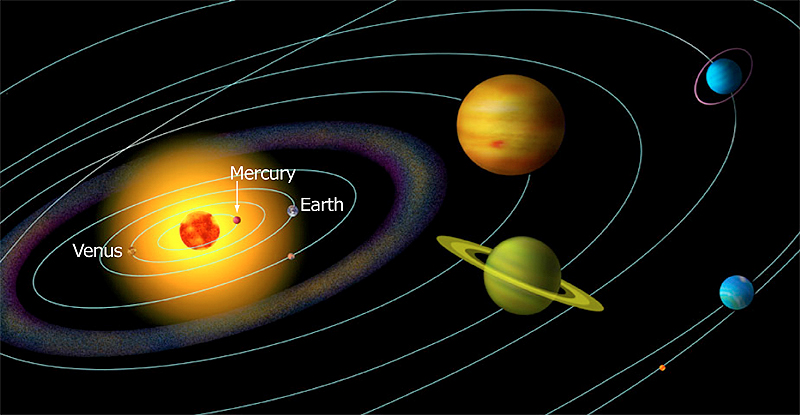
Or somewhat less obviously distorted like this:

Either of these images badly distorts the sizes of the planets, but they also badly distort the size of the sun. Even actual images of Mercury against the sun are hard to reconcile with real distances and sizes. This image makes it look like Mercury is very close to the sun (and oddly enough makes it look larger, relative to the sun than it actually is):
Try this image:

Those circles are orbits to scale, and the yellow dot in the center? That's the sun also to scale. The sun is huge but Mercury (black circle) orbits at a distance of 0.38 a.u., which is 41x the diameter of the sun--Venus is the gold circle, Earth blue and Mars red. Also, none of the planets are visible at this scale. The largest of this group, Earth, is .01 times the diameter of the sun, so if that sun were 100 pixels wide, Earth would be 1.
So as close as mercury is to the sun, it's still a fair distance (relative to the size of the sun), and the sun does not fill its sky (if you were on the surface of Mercury the sun would appear a bit less than 3x the diameter--9x the area--than it does here on Earth).
That last image isn't as nice to look at but our MASSIVE sun is still a tiny dot compared with the orbits of even the very close planets in our stellar system. The outer planets make these orbitals seem small, and our entire planetary system is a speck in the Milky Way which is less than a spec in the universe overall.
Thursday, May 05, 2016
Dept. of Late Comebacks
It would have been great if she could have responded: "That's ok, I prefer to give my money to decent human beings..." Or even "Hope your don't end up requiring the aid of a liberal surgeon with your disposition."
Thursday, April 28, 2016
Valid Point, Poor Article
I kind of agree with the point of this article about smug liberalism, but the article itself doesn't do a very good job of conveying the point (and you can probably look to this other Vox article for a good reason why).
There is certainly a fair amount of smug disdain from [more liberal] Democrats toward large elements of the Republican base, but pointing out all the ways that liberals are, in fact, correct, and that liberal positions have more soundly reasoned grounds is a poor way to convey that. Further, the Kim Davis example is particularly problematic since liberal women (see; Clinton, Pelosi, Sotomayor) are quite regularly attacked for their looks.
The problem is not that liberals are right and conservatives are wrong. The problem is that the Republican party itself is not interested in governing or allowing for government to function. It isn't ideology.
The problem is that people who don't agree, broadly, with the Democratic party don't have a capable, competent party to turn to. They have to vote Republican or not at all. Small parties like the Greens and Libertarians don't have sufficient standing to really impact things.
I am quite liberal myself, but I know that, aside from questions of fact (which are real, not smugness) there are other approaches to most problems/situations that I disagree with but which certainly can be valid. There is not really a home for those positions any more.
People who don't like Democratic positions have a choice between a party they don't agree with and one that is full of extremists, reactionaries and racists, and some of those people, who may be none of those things, will nevertheless vote for that party because they see it as the lesser of two evils...which, frankly is also what a lot of Democratic voters do.
There is certainly a fair amount of smug disdain from [more liberal] Democrats toward large elements of the Republican base, but pointing out all the ways that liberals are, in fact, correct, and that liberal positions have more soundly reasoned grounds is a poor way to convey that. Further, the Kim Davis example is particularly problematic since liberal women (see; Clinton, Pelosi, Sotomayor) are quite regularly attacked for their looks.
The problem is not that liberals are right and conservatives are wrong. The problem is that the Republican party itself is not interested in governing or allowing for government to function. It isn't ideology.
The problem is that people who don't agree, broadly, with the Democratic party don't have a capable, competent party to turn to. They have to vote Republican or not at all. Small parties like the Greens and Libertarians don't have sufficient standing to really impact things.
I am quite liberal myself, but I know that, aside from questions of fact (which are real, not smugness) there are other approaches to most problems/situations that I disagree with but which certainly can be valid. There is not really a home for those positions any more.
People who don't like Democratic positions have a choice between a party they don't agree with and one that is full of extremists, reactionaries and racists, and some of those people, who may be none of those things, will nevertheless vote for that party because they see it as the lesser of two evils...which, frankly is also what a lot of Democratic voters do.
Friday, April 15, 2016
Good Post By Krugman on Sanders/Clinton
Since I've given Paul Krugman lots of shit about many of his anti-Bernie columns I feel obligated to give kudos to a good anti-Bernie column. (Yes, despite the fact that he has no idea that I've been giving him shit nor would he care if he did know.)
I pretty much got his point of view from earlier columns but they were very dismissive of any point of view that would lead someone to support Sanders over Clinton, which, frankly is what is relevant. We are not looking at these two candidates vs. Platonic forms but vs. each other, and there are perfectly legitimate reasons to select either candidate depending on your personal preferences/ideas.
I also agree with Krugman's problems with Sanders, but I'm not sure I agree so much with him on Clinton. I think it is quite possible she learned the wrong lessons from Iraq and the financial crisis...not nothing as with Republicans, but still not the right lessons.
I pretty much got his point of view from earlier columns but they were very dismissive of any point of view that would lead someone to support Sanders over Clinton, which, frankly is what is relevant. We are not looking at these two candidates vs. Platonic forms but vs. each other, and there are perfectly legitimate reasons to select either candidate depending on your personal preferences/ideas.
I also agree with Krugman's problems with Sanders, but I'm not sure I agree so much with him on Clinton. I think it is quite possible she learned the wrong lessons from Iraq and the financial crisis...not nothing as with Republicans, but still not the right lessons.
Subscribe to:
Posts (Atom)