The main reason anyone doesn't get enough is because we (collectively) spend too much time not outside. On top of that we tend to slather on loads of sunscreen when we do go out meaning that we don't get our Vitamin D even then. Now this study saying infants are Vitamin D deprived, especially breast fed infants.
That breast fed infants are not getting enough Vitamin D should tell people that we are insanely over paranoid about going outside and the possibility of getting burned. Not that we should have to give an infant a dietary supplement. I know that there are dangers of overexposure to UV and that it is worse than it was 1000 years ago, but it is also overblown. If you are sensible about going outside--don't be outside in the sun from 12-3 unless you have to and then keep covered first use sunscreen second, don't wait until mid summer and 90 degree weather to get sun, if you skin starts to feel warm get in or under cover, ...--then there shouldn't be a problem.
It only takes 15 minutes of exposure to get your Vitamin D. Supplementing this is insanity, not good practice.
Thursday, May 13, 2010


Thursday, May 06, 2010
Hornet's Nest Being Kicked
When it comes to the gender pay gap, I'm very conflicted, mostly because I'm male.
First off, according to the linked report there are "legitimate" things that cover a good portion of the difference (80%). The remainder, the authors say, can be reasonably contributed to gender discrimination. Seeing as the resulting gender pay difference is only 5% one year out of college (women make 95% of what men make in the same professions), I'll buy that.
I will, unfortunately, follow that with: it isn't really possible to control for everything: imagine two companies that do the same thing, but one pays employees 20% more and is 90% male while the other pays less and is 50% male. Even if size and all other perks are the same, the former company is male dominated and might have a harder time attracting and keeping women (even if they were to favorably hire them). Of course, this is still gender discrimination, as the other company is effectively taking advantage of the fact that they can get top tier women at 80% the price by having more of them to start out with. This is still a problem.
I suppose what I never feel is well addressed is the question "What does 'gender discrimination' mean specifically?" The authors don't really answer that question effectively and that means their solutions to closing the pay gap end up short. So while many of their solutions make sense and are good, some, however, seem based on their own acceptance of societal gender discrimination.
Particularly when it comes to a few issues. So long as child care is perceived as benefiting women's employment it is likely to hurt their paychecks with respect to men's. Same with family leave. Same with using hours as the primary measure of productivity. Simply proposing these things as solutions is conceding that women can't achieve the same pay level without these aids which men don't need that cost companies money. I don't believe that.
I don't expect to be paid as much if I don't work as many hours as someone else. I don't expect to be paid as much if I require more time off per year for family or medical emergencies. I wouldn't expect to be paid as much if I have a child and make (use of) the company provided day care.
But those are all related to societal gender discrimination, not workplace. We happen to live in a society that believes men are more valuable in the workplace in part because it believes men are less valuable at home and as parents.
It is very likely that workplace gender discrimination is still prevalent (particularly going back in time) but so long as it is socially ingrained it won't go away. Things that force the issue do--rightly or wrongly--make men angry. If we can reach a point where men see things like day care at work and family leave as being of great benefit to them, and if we can reach a point where a man who is a stay-at-home dad taking care of the house and kids is not thought of as "unmanly" and if we can reach a point where a woman who works is not considered a horrible mother and if we can reach a point that a woman who marries down the economic ladder does not seem odd, then we will be able to have gender pay equity.
It is possible, of course, that forcing pay equity through pro female gender discrimination is an effective and good method to doing this. But pretending that those solutions are somehow fair in a world that they are required only to produce fairness for women, and not that they are a different form of gender discrimination required because of the gender discrimination that is societal is just dishonest.
First off, according to the linked report there are "legitimate" things that cover a good portion of the difference (80%). The remainder, the authors say, can be reasonably contributed to gender discrimination. Seeing as the resulting gender pay difference is only 5% one year out of college (women make 95% of what men make in the same professions), I'll buy that.
I will, unfortunately, follow that with: it isn't really possible to control for everything: imagine two companies that do the same thing, but one pays employees 20% more and is 90% male while the other pays less and is 50% male. Even if size and all other perks are the same, the former company is male dominated and might have a harder time attracting and keeping women (even if they were to favorably hire them). Of course, this is still gender discrimination, as the other company is effectively taking advantage of the fact that they can get top tier women at 80% the price by having more of them to start out with. This is still a problem.
I suppose what I never feel is well addressed is the question "What does 'gender discrimination' mean specifically?" The authors don't really answer that question effectively and that means their solutions to closing the pay gap end up short. So while many of their solutions make sense and are good, some, however, seem based on their own acceptance of societal gender discrimination.
Particularly when it comes to a few issues. So long as child care is perceived as benefiting women's employment it is likely to hurt their paychecks with respect to men's. Same with family leave. Same with using hours as the primary measure of productivity. Simply proposing these things as solutions is conceding that women can't achieve the same pay level without these aids which men don't need that cost companies money. I don't believe that.
I don't expect to be paid as much if I don't work as many hours as someone else. I don't expect to be paid as much if I require more time off per year for family or medical emergencies. I wouldn't expect to be paid as much if I have a child and make (use of) the company provided day care.
But those are all related to societal gender discrimination, not workplace. We happen to live in a society that believes men are more valuable in the workplace in part because it believes men are less valuable at home and as parents.
It is very likely that workplace gender discrimination is still prevalent (particularly going back in time) but so long as it is socially ingrained it won't go away. Things that force the issue do--rightly or wrongly--make men angry. If we can reach a point where men see things like day care at work and family leave as being of great benefit to them, and if we can reach a point where a man who is a stay-at-home dad taking care of the house and kids is not thought of as "unmanly" and if we can reach a point where a woman who works is not considered a horrible mother and if we can reach a point that a woman who marries down the economic ladder does not seem odd, then we will be able to have gender pay equity.
It is possible, of course, that forcing pay equity through pro female gender discrimination is an effective and good method to doing this. But pretending that those solutions are somehow fair in a world that they are required only to produce fairness for women, and not that they are a different form of gender discrimination required because of the gender discrimination that is societal is just dishonest.
Wednesday, May 05, 2010
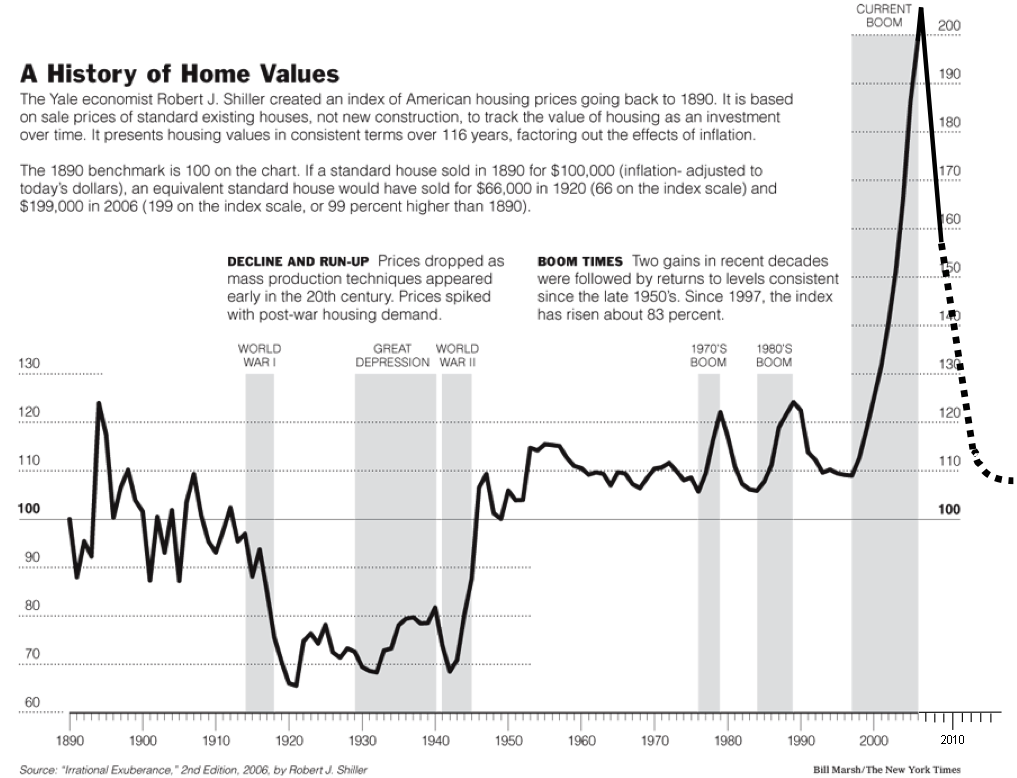
Housing and Inflation
Been playing with this.
I don't generally believe that thinking of a house as an investment is the right way to think. I mean, it is one, but it's not really a good one. When house prices are not being boosted by bankers gone wild they only grow at the same rate as wages (which is approximately that of inflation...most of the time). But what they really do is hedge your monthly living expenses against inflation.
If I buy a house now on a 30 year mortgage, my "rent" will stay static for 30 years then drop precipitously. Taxes are likely to change, so that isn't completely right, but that change is small compared to rents. Rents, like houses, tend to inflate with wages, but unlike houses, rents are locked in a year at a time. So next year, rent goes up, my mortgage doesn't. Same the year after and the year after that.
If I can have a mortgage payment that is only a little more than an equivalent rent (my mortgage is about the same or a little less than an equivalent rent) then I start gaining on the up front costs of purchasing after a few years. This is true whether or not the "value" of my house is increasing at a similar rate, or at all, and maybe even if it is falling.
People who plan on moving every 2-5 years don't necessarily get this benefit since the upfront costs to purchase takes a few years to wipe out and in the present economy will likely take a bit longer than normal.
To me this is one of the most important reasons to purchase. I like reading Patrick.net, but many of the rent vs own arguments I see there relate to immediate financials and not long term. If I can purchase a place at $2k/mo (mortgage + taxes + pmi/other) and rent the exact same place for $1700/mo it may look like renting is better (especially when factoring in closing costs), but that only holds for the short term.
This argument, of course, falls flat if we face deflation rather than inflation. So it is still a gamble, but even if you only listen to inflation skeptics (those that don't think we are likely to see high inflation starting in a year to a few years) you won't find many people arguing that we are likely to see much deflation, and that what we do see won't last. In fact many of the same people who have been arguing against buying houses (prices still need to come down!) also argue for buying gold! When it comes to a good hedge against inflation, historically, stocks do better than gold. Investments, however, are with extra money (what you don't need to live on) a is a way to use your monthly shelter payment (rent) as an additional hedge against inflation, and also maybe even as an investment (albeit a weak one).
I don't generally believe that thinking of a house as an investment is the right way to think. I mean, it is one, but it's not really a good one. When house prices are not being boosted by bankers gone wild they only grow at the same rate as wages (which is approximately that of inflation...most of the time). But what they really do is hedge your monthly living expenses against inflation.
If I buy a house now on a 30 year mortgage, my "rent" will stay static for 30 years then drop precipitously. Taxes are likely to change, so that isn't completely right, but that change is small compared to rents. Rents, like houses, tend to inflate with wages, but unlike houses, rents are locked in a year at a time. So next year, rent goes up, my mortgage doesn't. Same the year after and the year after that.
If I can have a mortgage payment that is only a little more than an equivalent rent (my mortgage is about the same or a little less than an equivalent rent) then I start gaining on the up front costs of purchasing after a few years. This is true whether or not the "value" of my house is increasing at a similar rate, or at all, and maybe even if it is falling.
People who plan on moving every 2-5 years don't necessarily get this benefit since the upfront costs to purchase takes a few years to wipe out and in the present economy will likely take a bit longer than normal.
To me this is one of the most important reasons to purchase. I like reading Patrick.net, but many of the rent vs own arguments I see there relate to immediate financials and not long term. If I can purchase a place at $2k/mo (mortgage + taxes + pmi/other) and rent the exact same place for $1700/mo it may look like renting is better (especially when factoring in closing costs), but that only holds for the short term.
This argument, of course, falls flat if we face deflation rather than inflation. So it is still a gamble, but even if you only listen to inflation skeptics (those that don't think we are likely to see high inflation starting in a year to a few years) you won't find many people arguing that we are likely to see much deflation, and that what we do see won't last. In fact many of the same people who have been arguing against buying houses (prices still need to come down!) also argue for buying gold! When it comes to a good hedge against inflation, historically, stocks do better than gold. Investments, however, are with extra money (what you don't need to live on) a is a way to use your monthly shelter payment (rent) as an additional hedge against inflation, and also maybe even as an investment (albeit a weak one).
This argument also falls flat if you buy a house at the wrong time and place, like, say 4 years ago in California. People who bought at the peak of the market may never recover their investment. Of course, people buying then were having to pay much more than what the equivalent rent would be.
Sunday, April 25, 2010
The Theme Is: Education
I quickly glanced down a list of jobs paying $30-$40/hr and one thing was very clear: you need an education to get them.
Just a quick note, full time at $30/hr is ~$60k/yr. What isn't clear is how the hourly rate is figured. Does the $30/hr that a kindergarten teacher make only count the hours that they have students in class? That doesn't necessarily translate to how much they actually work, and it does leave out the gaping hole in their income that results from nearly four months unpaid. Does "post secondary" mean professor or just lecturer, and if the latter, does that only count the 8-20 hrs/week that they actually spend in a classroom and holding office hours?
Still, the message is clear if already well known: you are better off with a college degree.
Just a quick note, full time at $30/hr is ~$60k/yr. What isn't clear is how the hourly rate is figured. Does the $30/hr that a kindergarten teacher make only count the hours that they have students in class? That doesn't necessarily translate to how much they actually work, and it does leave out the gaping hole in their income that results from nearly four months unpaid. Does "post secondary" mean professor or just lecturer, and if the latter, does that only count the 8-20 hrs/week that they actually spend in a classroom and holding office hours?
Still, the message is clear if already well known: you are better off with a college degree.
Thursday, April 22, 2010
Green is Cheap
I really don't think this message penetrates very well. I think mostly because of the very, very intense marketing we experience in this country. If you want to live "green" then: stop buying shit! Yes, also, don't live in a huge home. Don't fertilize the hell out of your yard. Don't leave your house lit up like Christmas every night. Keep the thermostat below 70 (or even better: 65) in the winter and above 75 (or even 80) in the summer. Don't take baths, and take fast showers.
But really, it is buying shit (particularly disposable shit but really pretty much anything) that is the problem. It has to be made, it has to be transported, it has to be disposed of. All of those things contribute carbon. That is true of food, furniture, toilet paper, baby wipes, every damned thing.
Of course, if people listened to that it would put an even bigger hurt on our economy, and frankly, most Americans don't really want to live "green" lifestyles as they kind of suck... I mean the nations with the lowest carbon footprints (per capita) tend to be among the world's poorest. Americans with the lowest carbon footprint also tend to be very poor (homeless, carless, and living in an urban setting).
No matter how "green" I become, I am responsible for a hell of a lot more carbon than an impoverished Bangladeshi. That would be true even if I were better than 95% of Americans (I'm not). Of course I'm orders of magnitude better than our nation's millionaires and billionaires.
But really, it is buying shit (particularly disposable shit but really pretty much anything) that is the problem. It has to be made, it has to be transported, it has to be disposed of. All of those things contribute carbon. That is true of food, furniture, toilet paper, baby wipes, every damned thing.
Of course, if people listened to that it would put an even bigger hurt on our economy, and frankly, most Americans don't really want to live "green" lifestyles as they kind of suck... I mean the nations with the lowest carbon footprints (per capita) tend to be among the world's poorest. Americans with the lowest carbon footprint also tend to be very poor (homeless, carless, and living in an urban setting).
No matter how "green" I become, I am responsible for a hell of a lot more carbon than an impoverished Bangladeshi. That would be true even if I were better than 95% of Americans (I'm not). Of course I'm orders of magnitude better than our nation's millionaires and billionaires.
Wednesday, April 21, 2010
Ok, So the Fix Is?
After bitching about Jamie Oliver, and reading Marc Ambinder's article on obesity, I figured that I should propose something that accomplishes what Jamie seems to be trying but that would actually work.
The obesity epidemic is huge, and the causes are varied and large themselves, as Marc very effectively points out. The solution, unfortunately, must be equal to it. As much as I dislike Marc's quick postulation about surgery for all, it--unlike Jamie's posturing--is a proposal that could really work. I don't like it though. Here are some other (maybe less unlikely to occur) things that together would do wonders:
1. End farm subsidies (at least increase subsidies for healthier farm products to match corn).
2. Tax soda (heavily) and pretty much any snack food and convenience food (chips, cookies, frozen pizza, dear God Hot Pockets!). More simply: tax anything that isn't produce (fresh, dried frozen or canned), or good grain products (whole grain breads, pasta, rice). Meat can be tax free as the ended subsidies will likely increase it's cost substantially. Really though, taxing soda and candy is a must.
3. Gas tax (min $2/gallon). People will drive less. This may also mean they will walk more. Also transportation costs will go up and so will the price of food shipped from further away, particularly for multi-shipped food (grain to mil, mill to cow, cow to slaughter/butcher, butcher to grocers). Many transport issues are actually not too bad other than the last one or two, but still...
4. Subsidize: public transit, biking lanes/trails, walking oriented development and growth.
There are two things making us fat: our diet and our activity level. We can't force people to exercise (or not eat cake) but we can make better eating cheaper and crappy eating more expensive, and we can make it easier for people to walk or bicycle, as opposed to driving. These things take a great deal of political will to happen, however, one that seems lacking today.
The obesity epidemic is huge, and the causes are varied and large themselves, as Marc very effectively points out. The solution, unfortunately, must be equal to it. As much as I dislike Marc's quick postulation about surgery for all, it--unlike Jamie's posturing--is a proposal that could really work. I don't like it though. Here are some other (maybe less unlikely to occur) things that together would do wonders:
1. End farm subsidies (at least increase subsidies for healthier farm products to match corn).
2. Tax soda (heavily) and pretty much any snack food and convenience food (chips, cookies, frozen pizza, dear God Hot Pockets!). More simply: tax anything that isn't produce (fresh, dried frozen or canned), or good grain products (whole grain breads, pasta, rice). Meat can be tax free as the ended subsidies will likely increase it's cost substantially. Really though, taxing soda and candy is a must.
3. Gas tax (min $2/gallon). People will drive less. This may also mean they will walk more. Also transportation costs will go up and so will the price of food shipped from further away, particularly for multi-shipped food (grain to mil, mill to cow, cow to slaughter/butcher, butcher to grocers). Many transport issues are actually not too bad other than the last one or two, but still...
4. Subsidize: public transit, biking lanes/trails, walking oriented development and growth.
There are two things making us fat: our diet and our activity level. We can't force people to exercise (or not eat cake) but we can make better eating cheaper and crappy eating more expensive, and we can make it easier for people to walk or bicycle, as opposed to driving. These things take a great deal of political will to happen, however, one that seems lacking today.
Tuesday, April 20, 2010
LHC Rap...Yes, it Sucks.
Not going to link the video. I mostly want to agree with Thoreau. The rap is bad. Very bad. It would be fine if done for something like Sesame Street, but the concepts are a bit to advanced (even when presented in simple terms as is done) for elementary school and younger children. It would be good as a intro to some high concepts in like a high school or college physics class, if it weren't for the fact that it is a horrible rap.
Many science dorks (myself included) will find it funny and cute. But it is not going to do science or scientists any favors used as general public outreach.
Many science dorks (myself included) will find it funny and cute. But it is not going to do science or scientists any favors used as general public outreach.
Friday, April 16, 2010
It's German for "The, Goldman Sachs, The!"
I would love for Goldman Sachs to die a flaming death, but in the unlikely event that they do, it will probably be a slow bleed. Propped up as much and as long as possible by their buddies in Treasury and at the Fed. At least long enough for all the principles to get their billions out and stick the rest of the stock holders with a massive loss.
Wednesday, April 14, 2010
Jamie Oliver - Spoiled Ignoramus
I'm not much of a Jamie Oliver fan. Not because of his food, but because he just comes off kind of ignorant and haughty. I, therefore, am tickled by his Food Revolution fall on his face. I first saw the clip on Colbert where he grinds up and seives chicken gunk (bones, cartilage, fat, skin, some scraps of meat) to fry then asks kids whether they want some of those chicken nuggets, and they all do!
I was happy. The main reason was that grossing people out of eating some foods--while effective on some level--is a bad idea. Plenty of people, were they to go to a slaughterhouse, would swear off meat. Most of those would return to eating meat within a week. More, how many people refuse to eat things that are good because of some arbitrary perception that it is gross? Grossing people out just doesn't work: people will go back to eating some things, and will use that as an excuse to not eat others.
On tom pf that, this chicken nugget thing to me was encouraging waste rather than healthy eating. It would be better if we ate more of each animal, fewer animals overall, and threw less away.
After reading the link, I got a bit more angry. It kind of distills Jamie down to his essence. Yes, it would be good for people to eat better, for many reasons. But many (probably most) people lack the time and money to have good quality meals on a regular basis, whether home made or premade (like Kashi). Good food is expensive, time consuming, or both. Jamie's attitude is more than a little arrogant. I like to cook, but I don't do so every day, because I am tired and don't have that much time. I probably do have the money to eat well even when I'm not cooking but I don't because I think it's too expensive. Plenty of people have less free time and money than me. Jamie Oliver is an ass.
I was happy. The main reason was that grossing people out of eating some foods--while effective on some level--is a bad idea. Plenty of people, were they to go to a slaughterhouse, would swear off meat. Most of those would return to eating meat within a week. More, how many people refuse to eat things that are good because of some arbitrary perception that it is gross? Grossing people out just doesn't work: people will go back to eating some things, and will use that as an excuse to not eat others.
On tom pf that, this chicken nugget thing to me was encouraging waste rather than healthy eating. It would be better if we ate more of each animal, fewer animals overall, and threw less away.
After reading the link, I got a bit more angry. It kind of distills Jamie down to his essence. Yes, it would be good for people to eat better, for many reasons. But many (probably most) people lack the time and money to have good quality meals on a regular basis, whether home made or premade (like Kashi). Good food is expensive, time consuming, or both. Jamie's attitude is more than a little arrogant. I like to cook, but I don't do so every day, because I am tired and don't have that much time. I probably do have the money to eat well even when I'm not cooking but I don't because I think it's too expensive. Plenty of people have less free time and money than me. Jamie Oliver is an ass.
Tuesday, April 13, 2010
Valuing Housing
For all I've read about mortgages being under water and house values falling I find it odd how arbitrary house "values" are.
A house is nominally worth what people will pay for it. But the only way to find out what a house is really worth to someone is to sell it. Even then, you are only finding out what that house is worth to a single person (or family) in some limited fashion (timing and who offers/can pay the most). In a case like an appraisal the value of the house is also arbitrary but in a different fashion. Look at other houses, see sale prices, figure differences, attach dollar figure to differences, take temperature of market and determine if adjustment is needed...get number, say that is what the house is worth.
The case of selling demonstrates the value of the home to just the specific buyer and seller combination in a purchase that has more emotion involved than other buying/selling decisions. The case of appraisal demonstrates the value that some third party guesses for the house.
One of the major deciding factors for a home price is the monthly payment. People tend to pay what they can afford and what they can afford is a monthly payment, not the total price.
This is why things like the negative amortization ARMs were able to drive house prices up, they drove monthly payments down. Having more DINKs (dual income no kids) also drives housing price up because they have more income and can afford a higher monthly payment. The later, however, will produce sustainable higher prices so long as the fraction of two income families remains constant or increases (it cannot do sustained growth as at some point the DINC fraction would get saturated). The former is doomed to failure.
Still, it is the monthly payment that people can afford and not the whole house. As such, along with bizarre financing and more income things like taxes, interest rates, down payment requirements, all alter the "value" of a house. So my house is not worth $100k or $200k but worth what I can and will pay per month for it, whatever that works out too, all things considered.
Despite lots of advantages, I was still a little wary about buying when I did because interest rates were very low, which inflated prices. The housing tax credit also increased prices, though less than it is now since it was not available to everyone then. On the other hand prices were depressed and I did qualify for the (very stupid) tax credit.
I'll do work on my house over the years and that may make it worth more or less. But my house has no meaningful value until and unless I (try to) sell it. Granted this is not entirely true as my property taxes are based on an imaginary value, but that value is as much political as real and the numbers there are laughable.
One particular place where this imaginary number was made meaningful was with HELOCs (home equity lines of credit). All of a sudden people could get a lot of real money (debt) based on the imaginary value of their home, and many people took out up to 100% of the value. I think that HELOCs are not bad, but they should be capped at something reasonable (50-80% of the lower of mortgaged or appraised value).
Ok, this is getting rambling, and has been a draft too long. I'm posting. May revise/tear down later.
A house is nominally worth what people will pay for it. But the only way to find out what a house is really worth to someone is to sell it. Even then, you are only finding out what that house is worth to a single person (or family) in some limited fashion (timing and who offers/can pay the most). In a case like an appraisal the value of the house is also arbitrary but in a different fashion. Look at other houses, see sale prices, figure differences, attach dollar figure to differences, take temperature of market and determine if adjustment is needed...get number, say that is what the house is worth.
The case of selling demonstrates the value of the home to just the specific buyer and seller combination in a purchase that has more emotion involved than other buying/selling decisions. The case of appraisal demonstrates the value that some third party guesses for the house.
One of the major deciding factors for a home price is the monthly payment. People tend to pay what they can afford and what they can afford is a monthly payment, not the total price.
This is why things like the negative amortization ARMs were able to drive house prices up, they drove monthly payments down. Having more DINKs (dual income no kids) also drives housing price up because they have more income and can afford a higher monthly payment. The later, however, will produce sustainable higher prices so long as the fraction of two income families remains constant or increases (it cannot do sustained growth as at some point the DINC fraction would get saturated). The former is doomed to failure.
Still, it is the monthly payment that people can afford and not the whole house. As such, along with bizarre financing and more income things like taxes, interest rates, down payment requirements, all alter the "value" of a house. So my house is not worth $100k or $200k but worth what I can and will pay per month for it, whatever that works out too, all things considered.
Despite lots of advantages, I was still a little wary about buying when I did because interest rates were very low, which inflated prices. The housing tax credit also increased prices, though less than it is now since it was not available to everyone then. On the other hand prices were depressed and I did qualify for the (very stupid) tax credit.
I'll do work on my house over the years and that may make it worth more or less. But my house has no meaningful value until and unless I (try to) sell it. Granted this is not entirely true as my property taxes are based on an imaginary value, but that value is as much political as real and the numbers there are laughable.
One particular place where this imaginary number was made meaningful was with HELOCs (home equity lines of credit). All of a sudden people could get a lot of real money (debt) based on the imaginary value of their home, and many people took out up to 100% of the value. I think that HELOCs are not bad, but they should be capped at something reasonable (50-80% of the lower of mortgaged or appraised value).
Ok, this is getting rambling, and has been a draft too long. I'm posting. May revise/tear down later.
Monday, April 12, 2010
Don't Get the Disgust

Over KFC's new "sandwich" the Double Down. It's really no different than eating chicken cordon bleu: a fried chicken cutlet wrapped around cheese and pig (ham). I suppose everyone is grossed out by the idea of meat as bread, but that's really more of a mental block than something that is actually disgusting. I can't see there being all this news if the double down was exactly the same but a bun was added around the outside of it. It's two pieces of fried chicken with cheese and bacon.
If this was served on a plate with the cheese and bacon on top of the chicken and along side some potato salad (or mac and cheese) and green beans, it'd be a $15 dinner and people would be saying how it was comfort food or some shit.
On top of all this the noteworthy lack of carbs in this means that, for a sizable chunk of our population, it counts as diet food!
I guess the main thing that bothers me is that the press coverage (like that of the ipad and Tiger Woods) of this is just stupid. It's a novelty item that should be relegated to a quick mention between real news.
Maybe if there was a piece of lettuce in there folks would back off, but then CNN wouldn't be giving KFC so much free advertising. So way to go KFC! Shame on you news media!
Thursday, April 08, 2010
Owning the Wrong Things
As I read through this story on a laid off individual living off his airline/hotel miles/points what most struck me is that the guy doesn't really own useful things. Specifically he owns neither residence nor transportation.
There's a lot of sense to renting for many people, even for a lifetime. But in the end, most people are going to be better off if, by some point in their life, they own a residence and/or a car. It's one thing if getting laid off means having to cut back on electricity use and going out to eat, and another if it means burning through savings then sleeping on the street or in shelters. It is so much harder to get back on your feet from that far down.
The other end of this is that he does own stuff (keeping it in a storage unit). This is, to me, a major issue. We own lots of stuff, but the big things, we don't. We rent or take out massive loans for residences. We lease or take out loans for cars. Hell, lots of people make payments on appliances and large electronics.
Housing is expensive, and it takes time to purchase (whether saving for years and paying cash or getting a mortgage and paying it off for years). Cars, while still pricey, are, however, easy enough to own, and if you can't afford either, maybe having tons of shoes/clothes/electronics/etc. is not the right way to go?
There's a lot of sense to renting for many people, even for a lifetime. But in the end, most people are going to be better off if, by some point in their life, they own a residence and/or a car. It's one thing if getting laid off means having to cut back on electricity use and going out to eat, and another if it means burning through savings then sleeping on the street or in shelters. It is so much harder to get back on your feet from that far down.
The other end of this is that he does own stuff (keeping it in a storage unit). This is, to me, a major issue. We own lots of stuff, but the big things, we don't. We rent or take out massive loans for residences. We lease or take out loans for cars. Hell, lots of people make payments on appliances and large electronics.
Housing is expensive, and it takes time to purchase (whether saving for years and paying cash or getting a mortgage and paying it off for years). Cars, while still pricey, are, however, easy enough to own, and if you can't afford either, maybe having tons of shoes/clothes/electronics/etc. is not the right way to go?
Sunday, April 04, 2010
So Much News
So little time to bitch. Le Sigh.
Health (insurance) reform: historic and probably right direction but not nearly enough. It pretty much ignores all the health care providers issues because people like doctors and it's really easy to conflate doctors with health care providers and so harder to deal with. Also: Democrats enacting Republican health care reform with zero Republican votes...Not really sure who won this 'cause I didn't. If the GOP wasn't dominated by crazy this would be a huge coup for them.
NCAA tournament this year: meh. It's always kind of fun to watch good games and upsets, but Dook is in the finals and Kansas lost early so it sucks. UNC seemed to wake up a bit in the NIT before losing in the finals. Hoping Butler wins, but not optimistic and probably won't watch much.
Financial reform: not so much looking like reform. Dems will strip away anything that may function because the Wall Street super-geniuses own them almost as much as they do Repubs, so we'll likely be going through the same thing again in 5-10 yrs. Only it'll be worse.
Obama still letting torturers roam free and refuses to return to the rule of law when it comes to brown skinned people who have been labeled as "terrorists" (whether arbitrarily or legitimately, we don't know), so he is still working hard on that EPIC FAIL on the part of his job that is actually part of his job (health care and financial regulation are largely Congressional issues).
Freaking Tiger Woods practicing golf and Apple releasing a lame product are apparently big news, so news media is still atrocious.
I still don't understand why becoming more like (random Western European or Scandinavian country here) is such a horrible thing. I mean: more happiness, less poverty, no one going bankrupt then being forced off medical treatment for some disease thanks to crappy/no insurance and insane costs. Oh, I get it: fewer ultra rich in the financial industry. That would be sad.
Yes, I know the argument is related to economic growth...So, apparently most right-wingers would rather live in China than France? Ok.
Israel is acting like a spoiled brat child, but it's anti-semetic to point that out, so let's we just give them billions worth of arms to go blow up some more Palestinians because someone threw rocks at a tank. If Israel could exist without a phenomenal amount of charity from us, I say: feel free to commit human rights abuses and suffer the consequences. They can't, so we suffer the consequences in terms of hatred directed our way from many Islamic nations/people. Our unending and unquestioned support of Israel supports terrorism, but anyone who says that must hate Jews. Or something. I don't know. I'm just a poor rational thinking type who clearly doesn't understand...something?
The Catholic Church looks destined to burn in hell. Irony or poetic justice? That the Catholic Church has been stridently anti-woman (and anti-sex) for a long damned time didn't seem to matter much, though, so maybe being pro-child rapist will turn out ok for them as well. Seems the wrong side to take though.
Health (insurance) reform: historic and probably right direction but not nearly enough. It pretty much ignores all the health care providers issues because people like doctors and it's really easy to conflate doctors with health care providers and so harder to deal with. Also: Democrats enacting Republican health care reform with zero Republican votes...Not really sure who won this 'cause I didn't. If the GOP wasn't dominated by crazy this would be a huge coup for them.
NCAA tournament this year: meh. It's always kind of fun to watch good games and upsets, but Dook is in the finals and Kansas lost early so it sucks. UNC seemed to wake up a bit in the NIT before losing in the finals. Hoping Butler wins, but not optimistic and probably won't watch much.
Financial reform: not so much looking like reform. Dems will strip away anything that may function because the Wall Street super-geniuses own them almost as much as they do Repubs, so we'll likely be going through the same thing again in 5-10 yrs. Only it'll be worse.
Obama still letting torturers roam free and refuses to return to the rule of law when it comes to brown skinned people who have been labeled as "terrorists" (whether arbitrarily or legitimately, we don't know), so he is still working hard on that EPIC FAIL on the part of his job that is actually part of his job (health care and financial regulation are largely Congressional issues).
Freaking Tiger Woods practicing golf and Apple releasing a lame product are apparently big news, so news media is still atrocious.
I still don't understand why becoming more like (random Western European or Scandinavian country here) is such a horrible thing. I mean: more happiness, less poverty, no one going bankrupt then being forced off medical treatment for some disease thanks to crappy/no insurance and insane costs. Oh, I get it: fewer ultra rich in the financial industry. That would be sad.
Yes, I know the argument is related to economic growth...So, apparently most right-wingers would rather live in China than France? Ok.
Israel is acting like a spoiled brat child, but it's anti-semetic to point that out, so let's we just give them billions worth of arms to go blow up some more Palestinians because someone threw rocks at a tank. If Israel could exist without a phenomenal amount of charity from us, I say: feel free to commit human rights abuses and suffer the consequences. They can't, so we suffer the consequences in terms of hatred directed our way from many Islamic nations/people. Our unending and unquestioned support of Israel supports terrorism, but anyone who says that must hate Jews. Or something. I don't know. I'm just a poor rational thinking type who clearly doesn't understand...something?
The Catholic Church looks destined to burn in hell. Irony or poetic justice? That the Catholic Church has been stridently anti-woman (and anti-sex) for a long damned time didn't seem to matter much, though, so maybe being pro-child rapist will turn out ok for them as well. Seems the wrong side to take though.
Monday, March 15, 2010
Interview with Evan Bayh
Ezra Klein has been landing some pretty good interviews of late. Even though he (often in the case of Paul Ryan) overtly disagrees with the interviewee. Today is with the soon to be retired Democratic Senator from Indiana: Evan Bayh. All and all a good read, though nothing earth shattering.
Mostly, however, it shows Bayh as a progressive at heart, despite his often having been demonized by progressives. I'm sure that there are still policy areas in which he is significantly more conservative than an average Dem, but it seems like he has his head on straight when it comes to how things should operate in the Senate, notably when it comes to deciding committee chairs.
The filibuster has been hammered all over the place lately, but one of the things that is also a bit of a sticker for many progressives is that Republicans do committee chairs much better than Democrats do. The result is ancient out of touch Dems, largely from places that are less progressive (like Montana and Iowa) chairing very important committees and forcing compromises that much of the base dislike in return for: absolutely nothing. Joe Freaking Lieberman is a committee chair and he hasn't been a Democrat in practice for a while.
I would prefer that chairs be determined by drawing names from a hat.
I should note that the seniority crap is pretty similar in the House, though that has notably changed under Pelosi to allow for some junior members to actually be more effective legislators. (typically the first termers have very little power, and can't affect legislation much, and so end up having a harder reelection fight than more senior incumbents). Not that house members with seniority were appreciative of the change.
Mostly, however, it shows Bayh as a progressive at heart, despite his often having been demonized by progressives. I'm sure that there are still policy areas in which he is significantly more conservative than an average Dem, but it seems like he has his head on straight when it comes to how things should operate in the Senate, notably when it comes to deciding committee chairs.
The filibuster has been hammered all over the place lately, but one of the things that is also a bit of a sticker for many progressives is that Republicans do committee chairs much better than Democrats do. The result is ancient out of touch Dems, largely from places that are less progressive (like Montana and Iowa) chairing very important committees and forcing compromises that much of the base dislike in return for: absolutely nothing. Joe Freaking Lieberman is a committee chair and he hasn't been a Democrat in practice for a while.
I would prefer that chairs be determined by drawing names from a hat.
I should note that the seniority crap is pretty similar in the House, though that has notably changed under Pelosi to allow for some junior members to actually be more effective legislators. (typically the first termers have very little power, and can't affect legislation much, and so end up having a harder reelection fight than more senior incumbents). Not that house members with seniority were appreciative of the change.
Sunday, March 14, 2010
I Find the Similarities Eerie
"Eerie" is a weird word, much like "weird" so I'm appreciative of the opportunity to use it.
The background to the title is the eerie comparison between the description of Asperger syndrome and me (I'm like a hypochondriac, but for ambiguous syndromes that could apply and won't likely land me in a hospital).
Hmm..Verbositiy check; abrupt transitions, check; literal interpretations, check; miscomprehension of nuance, not sure; use of metaphor [...], check; auditory perception deficits, check; pedantic, check (when not meaning pedestrian); formal/idiosyncratic, check; oddities in [...], check.
Oh dear God, yes. Well, not so much the "inflexible routines" part but really, yea.
Of course the big one with Asperger's is the lack of demonstrated empathy. I hesitate on this one, because I don't know exactly how to figure it. But, in the end, I really don't empathize well. Mostly I fake it because I can and do understand well. Really, though, I have to force myself to understand that when a friend is upset about something, she may not be so keen on listening to me bitch about some unrelated thing or that he may not be in the mood to play a game or watch a movie.
Plus, I am a scientist. Autism of some sort is practically a given.
The background to the title is the eerie comparison between the description of Asperger syndrome and me (I'm like a hypochondriac, but for ambiguous syndromes that could apply and won't likely land me in a hospital).
Although individuals with Asperger syndrome acquire language skills without significant general delay and their speech typically lacks significant abnormalities, language acquisition and use is often atypical. Abnormalities include verbosity, abrupt transitions, literal interpretations and miscomprehension of nuance, use of metaphor meaningful only to the speaker, auditory perception deficits, unusually pedantic, formal or idiosyncratic speech, and oddities in loudness, pitch, intonation, prosody, and rhythm.
Hmm..Verbositiy check; abrupt transitions, check; literal interpretations, check; miscomprehension of nuance, not sure; use of metaphor [...], check; auditory perception deficits, check; pedantic, check (when not meaning pedestrian); formal/idiosyncratic, check; oddities in [...], check.
People with Asperger syndrome often display behavior, interests, and activities that are restricted and repetitive and are sometimes abnormally intense or focused. They may stick to inflexible routines, move in stereotyped and repetitive ways, or preoccupy themselves with parts of objects.
Oh dear God, yes. Well, not so much the "inflexible routines" part but really, yea.
Of course the big one with Asperger's is the lack of demonstrated empathy. I hesitate on this one, because I don't know exactly how to figure it. But, in the end, I really don't empathize well. Mostly I fake it because I can and do understand well. Really, though, I have to force myself to understand that when a friend is upset about something, she may not be so keen on listening to me bitch about some unrelated thing or that he may not be in the mood to play a game or watch a movie.
Plus, I am a scientist. Autism of some sort is practically a given.
Tuesday, March 09, 2010
I'm Seeing More Riders
I take the train (SEPTA regional rail) to work on a semi-regular basis--I'll drive if I sleep late or need my car for something during/after work e.g. When I first started, shortly after I moved a year back, an average morning would see the train car I rode on roughly 1/8th occupied and an average of 5 people on my shuttle from the final train stop. Now I would put the train car at more than 1/4 full (nearly one person in every bench) and probably 8-12 people on the shuttle.
I'm not entirely sure why this is, but I do like the trend.
I'm not entirely sure why this is, but I do like the trend.
Friday, March 05, 2010
President of the United States
The office is defined in Article Two of the United States Constitution.
Section 1, Clause 8:
Section 3: Presidential Responsibilities
So for all the bluster about health care and Obama and the like: as of now those have nothing to do with his job. If they get passed and signed into law they will become a part of his job. In the mean time, things like prosecuting torturers and granting honest to god trials to accused criminals (even the dark skinned Muslim ones held in Gitmo) are his job.
President Barack Obama isn't doing his job.
I feel that this needs to be reiterated as often as possible, but if Obama neglects those things that are critical to preserving, protecting and defending the Constitution of the United States, if he refuses to allow for the rule of law for people labeled terrorists and for those who tortured them then he is NOT worth reelecting to the presidency. It may be that that will result in an even worse president, but I cannot bring myself to vote for a president who abdicates this most critical of responsibilities.
Section 1, Clause 8:
Before he enter on the Execution of his Office, he shall take the following Oath or Affirmation:Then there is a lot of outlaying presidential powers like Commander in Chief and that they can pardon folks and direct a cabinet. Then some bit on dealing with the Senate (advice and consent) with respect to appointments and treaties. Then we get to the meat (tofu for DFH's)--
- "I do solemnly swear (or affirm) that I will faithfully execute the Office of President of the United States, and will to the best of my ability, preserve, protect and defend the Constitution of the United States."
Section 3: Presidential Responsibilities
I would like to point out the fourth and fifth clauses above. Yes, the President must give a State of the Union, and can convene congress, and be the US representative to the world but those last two are how laws are enforced in this country. Congress creates laws, and the President enforces them. The Judiciary is essentially the arbitrating body in this, but clause 5 factors in to how justices are named (with the advice and consent of Senate, whenever Tom Coburn allows it).
- He shall from time to time give to the Congress Information of the State of the Union, and recommend to their Consideration such Measures as he shall judge necessary and expedient;
- he may, on extraordinary Occasions, convene both Houses, or either of them, and in Case of Disagreement between them, with Respect to the Time of Adjournment, he may adjourn them to such Time as he shall think proper;
- he shall receive Ambassadors and other public Ministers;
- he shall take Care that the Laws be faithfully executed, and
- shall Commission all the Officers of the United States.
So for all the bluster about health care and Obama and the like: as of now those have nothing to do with his job. If they get passed and signed into law they will become a part of his job. In the mean time, things like prosecuting torturers and granting honest to god trials to accused criminals (even the dark skinned Muslim ones held in Gitmo) are his job.
President Barack Obama isn't doing his job.
I feel that this needs to be reiterated as often as possible, but if Obama neglects those things that are critical to preserving, protecting and defending the Constitution of the United States, if he refuses to allow for the rule of law for people labeled terrorists and for those who tortured them then he is NOT worth reelecting to the presidency. It may be that that will result in an even worse president, but I cannot bring myself to vote for a president who abdicates this most critical of responsibilities.
Yea, the Constitution's Fucked...
KSM: no civilian trial for you. Of course, now Republicans will all love Obama and vote for lots of legislation he supports and also everyone will get their very own puppy (to practice torture on obviously).
And, yes, like almost always, I do like Glenn Greenwald's take and by "like" I mean "agree with and get very depressed by."
Finally, apparently, Wolf Blitzer is still refusing to comment on whether he is a child molester or pedophile. I'd love to believe that he is neither, but his silence on the issue is speaking volumes.
And, yes, like almost always, I do like Glenn Greenwald's take and by "like" I mean "agree with and get very depressed by."
Finally, apparently, Wolf Blitzer is still refusing to comment on whether he is a child molester or pedophile. I'd love to believe that he is neither, but his silence on the issue is speaking volumes.
Tuesday, March 02, 2010
"Real Food"
I like cooking. I'm not so keen on the cleanup but I like cooking (and eating the things I've cooked...usually).
I feel a certain smug superiority when I cook. It is healthy. It is cheap. I tend to cook with minimum prepared ingredients (I use almost exclusively dried beans e.g.). Mostly though, it tends to taste better than much of what I can get out.
Still, I think these people are idiots. There is nothing inherently wrong with "processed" food. Bags of frozen vegetables are "processed" food. The bag of frozen okra I cooked up with tomato and onion said: "Ingredients: Okra" and nothing else. The fact that the okra was chopped and flash frozen made it processed. It also made it easier to ship longer distances and made it so that it was less likely to rot on a shelf and go to waste. Frozen foods in general are less wasteful than fresh...which wouldn't so much matter if all groceries composted their produce waste.
Now, it is certainly true that we have a wealth of overly processed food in this country and I would never argue that cheeze wiz is a good thing to eat, and there is something environmental to be said about eating local as much as possible--especially with fresh produce and meats which have more limited shelf lives and so much reach the shelf faster. Eating "real" foods that exclude, e.g., lowfat milk and dried pasta, is, on the other hand, pretty fucking stupid.
One of the things I read in the article mentioned a steak and baked potato meal. Seriously? I've got a chicken chili at home that has some processed foods (canned tomatoes, dried beans, olive oil) that I know is better for a person than would be a steak and potato dinner. The tomatoes I stewed with the okra were from a can, and that was certainly healthier than either the steak or baked potato (actually that whole meal which added pan fried chicken thighs and baked sweet potato was healthier than the steak/potato combo-more fiber, more vitamins, less saturated fat, more antioxidants, and probably more good fat as I used x-virg olive oil in the okra).
So long as the ingredient list of whatever it is you are eating is made up of food, it's fine. Even some of the unidentifiable shelf extenders are not bad: they mean less waste. I am more into not wasting food than I am into making sure I get lots of fresh or "never frozen" anything. I tend to get a lot of frozen veggies, canned tomatoes and dried beans/grains because they keep for ever. I run through onion, carrots and celery like crazy, and other root veggies have long shelf lives, so I can get those in the produce section, but I don't like waste, and the first thing mentioned was to throw away a bunch of food.
Pretentious, wasteful, earth-hating, holier-than-thou type idiots.
I feel a certain smug superiority when I cook. It is healthy. It is cheap. I tend to cook with minimum prepared ingredients (I use almost exclusively dried beans e.g.). Mostly though, it tends to taste better than much of what I can get out.
Still, I think these people are idiots. There is nothing inherently wrong with "processed" food. Bags of frozen vegetables are "processed" food. The bag of frozen okra I cooked up with tomato and onion said: "Ingredients: Okra" and nothing else. The fact that the okra was chopped and flash frozen made it processed. It also made it easier to ship longer distances and made it so that it was less likely to rot on a shelf and go to waste. Frozen foods in general are less wasteful than fresh...which wouldn't so much matter if all groceries composted their produce waste.
Now, it is certainly true that we have a wealth of overly processed food in this country and I would never argue that cheeze wiz is a good thing to eat, and there is something environmental to be said about eating local as much as possible--especially with fresh produce and meats which have more limited shelf lives and so much reach the shelf faster. Eating "real" foods that exclude, e.g., lowfat milk and dried pasta, is, on the other hand, pretty fucking stupid.
One of the things I read in the article mentioned a steak and baked potato meal. Seriously? I've got a chicken chili at home that has some processed foods (canned tomatoes, dried beans, olive oil) that I know is better for a person than would be a steak and potato dinner. The tomatoes I stewed with the okra were from a can, and that was certainly healthier than either the steak or baked potato (actually that whole meal which added pan fried chicken thighs and baked sweet potato was healthier than the steak/potato combo-more fiber, more vitamins, less saturated fat, more antioxidants, and probably more good fat as I used x-virg olive oil in the okra).
So long as the ingredient list of whatever it is you are eating is made up of food, it's fine. Even some of the unidentifiable shelf extenders are not bad: they mean less waste. I am more into not wasting food than I am into making sure I get lots of fresh or "never frozen" anything. I tend to get a lot of frozen veggies, canned tomatoes and dried beans/grains because they keep for ever. I run through onion, carrots and celery like crazy, and other root veggies have long shelf lives, so I can get those in the produce section, but I don't like waste, and the first thing mentioned was to throw away a bunch of food.
Pretentious, wasteful, earth-hating, holier-than-thou type idiots.
Subscribe to:
Posts (Atom)