Showing posts with label fun. Show all posts
Showing posts with label fun. Show all posts
Wednesday, September 11, 2019
Wait, That's Real?
I thought this Politicon post was a joke [image]. It seems to be a real thing. And it looks horrible. Why would anyone subject themselves to that?


Tuesday, May 21, 2019
GoT Final Season
So Game of Thrones series finale was this past Sunday. Even though I'm "satisfied" with the general conclusion I really didn't like this season at all (Vox has lots of articles on this season, I'm kinda partial to this one). It was a mess, and I think largely because they cut these past two seasons down to 7 & 6 episodes meaning they had to rush through everything. Last season could be boiled down to: kill everyone on the periphery off, and this one was: the conclusion needs to happen so it will, even though it won't make sense because we didn't put in the time and effort to bring viewers along.
I felt like we were watching the cliffs notes version of a series (which, at some level, we probably were). Daenerys's arc seems arbitrary, but more time (last season and this one) may have allowed her sense of isolation from these new allies and would-be subjects to make more sense. Ser Brienne gets her due then turns into a bad trope. Jon is, as he has been for most of the series, pretty much like a puppy: loyal and cute but not all that bright. Sansa is the best handled character but her very sensible statement that the North would be independent, was met with shrugs? No one else there thought "Hey, wait, I'd like to be independent too," or "I think having the North split off will be problematic so we shouldn't let that happen."? and so much more...
I really hope GRRM finishes the books because that will have to be a better version of this ending, but I can see how this ending could work. It just didn't because the whole last two seasons have been lacking in the character development necessary to make it work.
I felt like we were watching the cliffs notes version of a series (which, at some level, we probably were). Daenerys's arc seems arbitrary, but more time (last season and this one) may have allowed her sense of isolation from these new allies and would-be subjects to make more sense. Ser Brienne gets her due then turns into a bad trope. Jon is, as he has been for most of the series, pretty much like a puppy: loyal and cute but not all that bright. Sansa is the best handled character but her very sensible statement that the North would be independent, was met with shrugs? No one else there thought "Hey, wait, I'd like to be independent too," or "I think having the North split off will be problematic so we shouldn't let that happen."? and so much more...
I really hope GRRM finishes the books because that will have to be a better version of this ending, but I can see how this ending could work. It just didn't because the whole last two seasons have been lacking in the character development necessary to make it work.
Friday, April 05, 2019
Present Day As Seen from THE FUTURE!
This is an interesting thought project, and there are several things on there that are probably right, but, like all prediction things, mostly probably wrong or, at best, not right.
I haven't gotten through all of them. The eating meat one seemed perfunctory, and there is a solid argument to be made there, but that article itself was just bad (for me it was much more eye-roll inducing than thoughtful, for reasons that should be obvious). The abortion one I have not read yet, but it is another that there is a solid argument for yet I'm suspicious that the article will be any good. Some are already being looked at as bad (tackle football for kids, the drug war...), others seem to require a very specific idea about something to view it as bad (401k's, no bosses). Still others seem more like fantasy notions from Star Trek fans (conspicuous consumption, Facebook and Google)--not that they're wrong about the bad, but the future isn't likely to bend that way.
Probably more interesting than useful, but it is more of a fun read than most news these days.
I haven't gotten through all of them. The eating meat one seemed perfunctory, and there is a solid argument to be made there, but that article itself was just bad (for me it was much more eye-roll inducing than thoughtful, for reasons that should be obvious). The abortion one I have not read yet, but it is another that there is a solid argument for yet I'm suspicious that the article will be any good. Some are already being looked at as bad (tackle football for kids, the drug war...), others seem to require a very specific idea about something to view it as bad (401k's, no bosses). Still others seem more like fantasy notions from Star Trek fans (conspicuous consumption, Facebook and Google)--not that they're wrong about the bad, but the future isn't likely to bend that way.
Probably more interesting than useful, but it is more of a fun read than most news these days.
Tuesday, August 07, 2018
Big Houses
I'm not a fan of the McMansion, and, consequently, a big fan of mcmansionhell and Kate Wagner. One of the big problems with these houses is just the size for size sake. My house is 2000 sq ft. (respectable but still large), has 4 bedrooms, 2.5 bath, kitchen, one living room, dining "room". I've been in houses that were twice that size but had the same room breakdown (often with a 2nd living room). That's twice as much space but no more functionality, and tends to lead to just weird useless spaces. Do you need 600 sq ft for a master bedroom? 400 for a master bath? How about a formal "living room" that's really just decorative?
That said, There are a lot of old houses around me that are 3000 - 6000 sq ft. Many were built smaller and expanded over the years, but there are plenty of old houses that are quite large. They don't feel as monstrous and stupidly overbuilt as modern mcmansions, however, and while I'm not entirely sure why, I've a couple ideas. (Note: the 10000+ sq ft realm for older actual mansions is a different category...almost all modern "homes" in that size range are just more ridiculous versions of the smaller 4k sq ft mcmansions)
First is these older houses, unless they've been updated almost always have more closed off interior spaces (i.e. separate rooms) with normal height ceilings--up to 10' but often 8-9. The necessary connecting hallways in this configuration add square feet, but don't feel as useless as the foyer of an open concept modern house. Often a big block of the square footage is from a finished attic and/or basement, which may serve the same purpose of a second living area, but by not being on the main floor they don't seem as superfluous. The other reason is that the architectural design and layout don't seem forced. These houses are mostly boxes with fairly simple/straightforward/purpose-driven roofs, facades, and lines. There just aren't as many weird not-spaces as you find in modern mcmansions. (They also tend to have one car, and on rare occasion 2-car garages that are either detached, or basement, or behind the main house...garages--specifically the garage doors--are, in general, not attractive features on houses.)
This doesn't mean all these large, old houses are without wasted space, but they often don't feel as gross as their modern equivalents.
That said, There are a lot of old houses around me that are 3000 - 6000 sq ft. Many were built smaller and expanded over the years, but there are plenty of old houses that are quite large. They don't feel as monstrous and stupidly overbuilt as modern mcmansions, however, and while I'm not entirely sure why, I've a couple ideas. (Note: the 10000+ sq ft realm for older actual mansions is a different category...almost all modern "homes" in that size range are just more ridiculous versions of the smaller 4k sq ft mcmansions)
First is these older houses, unless they've been updated almost always have more closed off interior spaces (i.e. separate rooms) with normal height ceilings--up to 10' but often 8-9. The necessary connecting hallways in this configuration add square feet, but don't feel as useless as the foyer of an open concept modern house. Often a big block of the square footage is from a finished attic and/or basement, which may serve the same purpose of a second living area, but by not being on the main floor they don't seem as superfluous. The other reason is that the architectural design and layout don't seem forced. These houses are mostly boxes with fairly simple/straightforward/purpose-driven roofs, facades, and lines. There just aren't as many weird not-spaces as you find in modern mcmansions. (They also tend to have one car, and on rare occasion 2-car garages that are either detached, or basement, or behind the main house...garages--specifically the garage doors--are, in general, not attractive features on houses.)
This doesn't mean all these large, old houses are without wasted space, but they often don't feel as gross as their modern equivalents.
Thursday, January 12, 2017
Self Driving Cars
Atrios's new bugaboo it seems. He's right that we won't get there so long as there isn't something that forces us to. That is, that last 1% (or 0.1%...) can probably only come from mandated full implementation of autonomous vehicles. The issues/problems he describes are due to human drivers. If all cars are autonomous and speak to each other (via street grid) then all of those things either go away or can be dealt with.
Of course, that type of mandate won't happen until a critical mass of vehicles out there are "Autonomous-ready" and that isn't likely to happen in my lifetime.
Of course, that type of mandate won't happen until a critical mass of vehicles out there are "Autonomous-ready" and that isn't likely to happen in my lifetime.
Thursday, January 05, 2017
Must Have a Pickup to be a Real 'Murican
The trend in pickup trucks is both fascinating and idiotic to me. A pickup is traditionally half a car, with a bed that is useful for hauling stuff. Everyone needs to have a friend/neighbor with a pickup, but almost no one should have a pickup themselves.
30 years back, pickups were cheaper than cars because they were less useful (to most people) than cars. Today, however, they are some of the most expensive. The cheapest base model F150 Ford offers (just under $27k) is more expensive than the base model of every car they offer except the Taurus (just over $27k). Chevy is a bit better because they have the lower tier Colorado (Ford no longer offers a Ranger) but that is still starts out more expensive than 3 of their 5 cars.
The other thing is that more and more of these trucks are less and less useful. You have to go out of your way to get a bed that will hold a standard sheet of plywood flat with the tailgate up. Now, you may not see any reason to have that, but then, why the hell are you considering a truck? Also, many of the bigger trucks you see, e.g. on the road in Houston, are jacked up to the point that accessing the bed is nearly impossible, and certainly not useful for hauling since you'll need an elevator or installed lift gate to get things in and out.
If your truck is a fashion accessory, fine I guess, I just think it's stupid (as I think most fashion related things are stupid).
30 years back, pickups were cheaper than cars because they were less useful (to most people) than cars. Today, however, they are some of the most expensive. The cheapest base model F150 Ford offers (just under $27k) is more expensive than the base model of every car they offer except the Taurus (just over $27k). Chevy is a bit better because they have the lower tier Colorado (Ford no longer offers a Ranger) but that is still starts out more expensive than 3 of their 5 cars.
The other thing is that more and more of these trucks are less and less useful. You have to go out of your way to get a bed that will hold a standard sheet of plywood flat with the tailgate up. Now, you may not see any reason to have that, but then, why the hell are you considering a truck? Also, many of the bigger trucks you see, e.g. on the road in Houston, are jacked up to the point that accessing the bed is nearly impossible, and certainly not useful for hauling since you'll need an elevator or installed lift gate to get things in and out.
If your truck is a fashion accessory, fine I guess, I just think it's stupid (as I think most fashion related things are stupid).
Wednesday, December 14, 2016
Meadowlands Development
The project at the Meadowlands in NJ (formerly Xanadu, now American Dream) is one of Atrios's bugaboos and is fun to read whatever he digs up.
I'm a mall skeptic in the era of Amazon, but not a shopping and entertainment complex skeptic. The particulars of this project do seem really bad. The question should be how do people get around and how do they get there? Mall of America in MN is surrounded by people who drive to get everywhere, and is in a fairly modestly populated area so driving to get everywhere works.
The Meadowlands is just outside of NYC in northern NJ in one of the most densely populated parts of our country. Yea, some people drive, but more than half of NYC residents don't even own a car, and it's the only city in the US with >50% of people who commute via transit (if you just say "not by car" that number goes up quite a bit). In addition, while there is more driving in Jersey and upstate NY, there is still far more train and bus riding that in the midwest. In fact of the 6 cities to crack 20% transit ridership, Washington DC, Boston, Philadelphia join NYC as northeast transit cities (Chicago and San Francisco are the remaining 2) with Baltimore just missing the 20% cut. In the rest of the US, only Seattle, Portland and LA manage to top 10%.
If they want that place to work, they're going to need a dedicated train stop that is just outside the doors, not across a street and 1000 ft. of parking lot. I'm not sure if that's going to happen, but even if it does, it's still a huge question mark because of the rest of the northeast. There are mountains and an ocean, there are several major cities including NYC and DC. There are plenty of amusement parks, and there is already a lot of shopping around (including plenty of high end). Is a shopper really going to see that mall as better than NYC or even the existing malls around (including King of Prussia and multiple outlet malls)? Is someone interested in the amusement park aspect going to find that a better option than any of the amusement/water parks in the area (including indoor options)?
The only way it works is that people who don't have easy access to various cities, parks, beaches, et cetera, can get here and the only way that happens is with good, easy transit access. Even ignoring the "parking lots are a blight" aspect, if this place relies on drivers, its doomed.
I'm a mall skeptic in the era of Amazon, but not a shopping and entertainment complex skeptic. The particulars of this project do seem really bad. The question should be how do people get around and how do they get there? Mall of America in MN is surrounded by people who drive to get everywhere, and is in a fairly modestly populated area so driving to get everywhere works.
The Meadowlands is just outside of NYC in northern NJ in one of the most densely populated parts of our country. Yea, some people drive, but more than half of NYC residents don't even own a car, and it's the only city in the US with >50% of people who commute via transit (if you just say "not by car" that number goes up quite a bit). In addition, while there is more driving in Jersey and upstate NY, there is still far more train and bus riding that in the midwest. In fact of the 6 cities to crack 20% transit ridership, Washington DC, Boston, Philadelphia join NYC as northeast transit cities (Chicago and San Francisco are the remaining 2) with Baltimore just missing the 20% cut. In the rest of the US, only Seattle, Portland and LA manage to top 10%.
If they want that place to work, they're going to need a dedicated train stop that is just outside the doors, not across a street and 1000 ft. of parking lot. I'm not sure if that's going to happen, but even if it does, it's still a huge question mark because of the rest of the northeast. There are mountains and an ocean, there are several major cities including NYC and DC. There are plenty of amusement parks, and there is already a lot of shopping around (including plenty of high end). Is a shopper really going to see that mall as better than NYC or even the existing malls around (including King of Prussia and multiple outlet malls)? Is someone interested in the amusement park aspect going to find that a better option than any of the amusement/water parks in the area (including indoor options)?
The only way it works is that people who don't have easy access to various cities, parks, beaches, et cetera, can get here and the only way that happens is with good, easy transit access. Even ignoring the "parking lots are a blight" aspect, if this place relies on drivers, its doomed.
Wednesday, November 16, 2016
Self Control Ain't What It Is
Diet, exercise, spending, and saving are all considered demonstration of self-control or a lack thereof, but that is probably not the right way to think about it according to a study discussed in this article. It's apparently just that people with better habits aren't tempted as much. Possibly because they have better habits.
I also think there is something to be said about the relative ease of different activities. If you have to spend half an hour getting ready to get exercise then you aren't going to do it very often, even if you like it. If healthy eating requires lots of prep work and lots of cleanup then that becomes less likely too. This is why mostly automated saving in 401k's is better than someone personally moving money into a savings/investment/retirement account and why the fully automated social security program is even better.
Monday, October 31, 2016
Zombies
I don't watch Walking Dead, mostly because I think Rick is (perhaps appropriately) a cartoon character and not particularly likable. That said, zombies are fun. This zombie infection calculator is neat, but I think it is missing something, namely, transportation. While a zombie may cover ground at a walking/running pace an infected but not yet zombie could get in a car and move lots faster.
The actual infection rate would probably depend pretty heavily on awareness and countermeasures. So that calculator is probably wrong but it's not clear how to make it better.
In Which I Discuss Krugman and Economics
Short post this, as it's really a thought more than an actual discussion or criticism. Out of this post of Krugman's--a comment on transportation costs and technologies--is this bit:
The transportation cost of digital items is approaching zero--there is a bandwidth cost, so it's not = 0 but it's pretty damn close. Krugman doesn't seem to be able to envision a future where technological improvements could do something similar for physical items--odd for a sci-fi fan. There are people who thought that 3D printers might make the same thing happen for actual physical objects...and they still could, but only if they get a lot better--don't think 3D printers, think Star Trek replicators.
There a whole lot of economic questions/problems with this happening, but it isn't something that can't happen. We're already partway there with information related things (games, books, music).
As I see it, we had some big technological advances in transportation — containerization, probably better communication making it easier to break up the value chain; plus the great move of developing countries away from import substitution toward export orientation. (That’s a decline in tau and t in my toy model.) But this was a one-time event. Now that it’s behind us, no presumption that trade will grow faster than GDP.That sounds, at some level, right, but it is backwards looking only and seems to ignore the phenomenon that is the internet. Yes, if I order a good chef's knife from Amazon then that has to be transported to me. But if I order a book for Kindle/Nook or a digital video game off Amazon or Steam, then I'm still getting something, and that is a something that would have required transportation even 10 years ago (in most cases) because the digital online sales of those items just didn't really exist yet.
The transportation cost of digital items is approaching zero--there is a bandwidth cost, so it's not = 0 but it's pretty damn close. Krugman doesn't seem to be able to envision a future where technological improvements could do something similar for physical items--odd for a sci-fi fan. There are people who thought that 3D printers might make the same thing happen for actual physical objects...and they still could, but only if they get a lot better--don't think 3D printers, think Star Trek replicators.
There a whole lot of economic questions/problems with this happening, but it isn't something that can't happen. We're already partway there with information related things (games, books, music).
Tuesday, September 20, 2016
Elizabeth Warren is Awesome!
They were talking on the radio about the Wells Fargo CEO taking "responsibility" which, I thought, was odd, since, he still has the job, and all the money he's earned, and will continue to make lots of money and get a big bonus. I'm not sure what kind of "responsibility" he is taking other than saying the words. So Sen. Warren tore into him and I feel (somewhat) better about things.
Tuesday, July 12, 2016
Pokemon Go Economy
I think the writer of this gets one thing wrong about how apps, specifically like Pokemon Go can interact with local economies. While the "internet destroys local business" is actually correct in a lot of ways, augmented reality apps like Pokemon Go could actually turn that around. The reason is that, while a normal game leaves me in my living room, this one gets me out into the world around. I was at my train station last night (walking dog but also hitting pokestops and catching pokemon when their servers allowed) and there were 8 people sitting there and I saw another half a dozen at least walk by. There isn't anything open there that time of night, but what if there was a bar, or ice cream shop or all night diner--better one with free wifi?
And it doesn't have to be food/drink related (just those are easier things to pop into small spaces), It could be shopping or recreational. If people are going to walk around a lot more, they are more likely to pop in and out of places they walk by--even if most don't--so being near a gym or pokestop has advantages for businesses that know to take advantage. Additionally, someone could imagine something like Pokemon Go busses being set up...particularly in areas where the critters are less populous and pokestops are fewer and further between.
But really, augmented reality type games, by their nature, could be a boon to local economies. Local businesses could have stakes in the games, where they need to authenticate something, or where they could, instead of advertising, pay to have their place of business be a stop for something. Maybe a virtual pet can be trained regularly, but if you get at least 8 oz at a DIY frozen yogurt place you can "feed" your pet some and it gets a special trait, or it levels up faster (a one time bar code prints out on your receipt). Basically a purchase at a store has an ancillary purchase associated in a game.
And it doesn't have to be food/drink related (just those are easier things to pop into small spaces), It could be shopping or recreational. If people are going to walk around a lot more, they are more likely to pop in and out of places they walk by--even if most don't--so being near a gym or pokestop has advantages for businesses that know to take advantage. Additionally, someone could imagine something like Pokemon Go busses being set up...particularly in areas where the critters are less populous and pokestops are fewer and further between.
But really, augmented reality type games, by their nature, could be a boon to local economies. Local businesses could have stakes in the games, where they need to authenticate something, or where they could, instead of advertising, pay to have their place of business be a stop for something. Maybe a virtual pet can be trained regularly, but if you get at least 8 oz at a DIY frozen yogurt place you can "feed" your pet some and it gets a special trait, or it levels up faster (a one time bar code prints out on your receipt). Basically a purchase at a store has an ancillary purchase associated in a game.
Thursday, June 16, 2016
Space
This is just really neat. Got there through a link off one of the Astronomy Pictures of the Day.
Wednesday, June 15, 2016
The Issue Is Going To Be Storage
This is the right way, in general, to think about next gen energy market. Smaller, distributed generation points will be linked with better software to maximize efficiency. The problem, which is not mentioned here, is storage. We need a lot of energy storage to accommodate peak demand, and peak efficiency offsets. Much more with renewable energy technologies since things like solar and wind can't be brought on and offline in the same way that a gas power plant can.
I was at PNNL a couple weeks back listening and talking with lots of people thinking about this problem. Software does help a lot, but we still need some technology breakthrough that will let us get the storage we need. Geographically limited pumped hydro is still the king. Flow batteries seem to be the most promising new(er) technology, though they aren't quite there yet. Other battery technologies/improvements are still mostly geared toward portability and mobility, though if they can be brought down in cost and improved in cycle life they could be used to the same end.
I was at PNNL a couple weeks back listening and talking with lots of people thinking about this problem. Software does help a lot, but we still need some technology breakthrough that will let us get the storage we need. Geographically limited pumped hydro is still the king. Flow batteries seem to be the most promising new(er) technology, though they aren't quite there yet. Other battery technologies/improvements are still mostly geared toward portability and mobility, though if they can be brought down in cost and improved in cycle life they could be used to the same end.
Wednesday, June 08, 2016
Maybe but...
Not really of much consequence, but while not everything is a 1977 computer there are a couple things that could be, and he mentions one (variant) in that article multiple times: Google glass.
If you could put on a pair of glasses that looked like regular eyeglasses but enabled some form of, augmented reality, then I suspect that would be very popular, and improved computing (and software) could make that real in the future. The issue with Google Glass is that you are obviously wearing Google Glass, and unless you're a big fan of cosplaying as the Borg then it's probably not too appealing to you.
As a second aside, the author mentions that he thinks self-driving cars are going to be big, and while I agree that they could be possible in the future, it isn't the capability so much as implementation that I think will hold them back. Getting people to give up control is more of a hindrance than making a vehicle capable of driving itself.
Friday, May 13, 2016
Tiny Houses are Fun But Not That Useful
I am a fan of tiny houses, and the idea of one for a cabin in the woods is kind of compelling, but they aren't really great ideas for real living. This article tries to "make a case against" them, but such case is not really well made.
It's true that the tiny house is particularly bad for cities, but there are some cases for which it could be more useful: mother-in-law suites or rental units (zoning issues), park "cabins". A lot of the actual stated use for these homes, however, could be equally well made for RV's and trailer/mobile homes. So what's the real deal?
I think there is a pretty big snob factor. RV's and actual inexpensive houses in the country (whether trailer or prefab...or small old row homes, though that last has gotten trendy in the past 15 yrs or so) tend to carry a stigma, partly from their appearance but more from the people who use them, which in the former case tend to be old and the latter case poor. Younger to middle aged people with middle incomes don't see themselves as part of the RV group or as trailer [trash] either. Hence: tiny houses, that look a lot like regular houses, just shrunk down.
Really, though, other than bragging rights, there isn't really much benefit to shrinking down below a certain point--say 300 sq.ft. plus 100 sq.ft. per person. In fact a larger house with more people in it is likely to be more efficient than separate smaller houses for individual people, which shouldn't be surprising, as that explains why people get roommates...and why adding family members (having children) becomes cheaper (per child) as the # increases.
Still, they are cute, and it can be fun to envision that tiny house in some expansive setting: the ocean, mountains...but really, if you can afford the land, you can build a better, more efficient home, and if you just want to move it to different places: get an RV...some of those are pretty cute too.
Also, I appreciate the push-back against the gargantuan. 3000+ square foot homes are, frankly, insane, unless you have 7 kids. Also, most of the really large homes are so full of useless space and awkward layouts, that a 3200 sq. ft. house is functionally equivalent to an efficiently laid out 1500 sq ft house. "Here we have a 150 sq. ft. entryway, where no one will ever hang out, that has vaulted ceilings and impossible to clean nooks, which still needs to be heated and cooled..." Lots of extra volume to heat and cool (and fill with crap, and clean). I don't get it. If you're going to have a house that size you should at least have secret passages/hidden rooms. The amount of dead space and oversized rooms in modern mcmansions is just stupid.
It's true that the tiny house is particularly bad for cities, but there are some cases for which it could be more useful: mother-in-law suites or rental units (zoning issues), park "cabins". A lot of the actual stated use for these homes, however, could be equally well made for RV's and trailer/mobile homes. So what's the real deal?
I think there is a pretty big snob factor. RV's and actual inexpensive houses in the country (whether trailer or prefab...or small old row homes, though that last has gotten trendy in the past 15 yrs or so) tend to carry a stigma, partly from their appearance but more from the people who use them, which in the former case tend to be old and the latter case poor. Younger to middle aged people with middle incomes don't see themselves as part of the RV group or as trailer [trash] either. Hence: tiny houses, that look a lot like regular houses, just shrunk down.
Really, though, other than bragging rights, there isn't really much benefit to shrinking down below a certain point--say 300 sq.ft. plus 100 sq.ft. per person. In fact a larger house with more people in it is likely to be more efficient than separate smaller houses for individual people, which shouldn't be surprising, as that explains why people get roommates...and why adding family members (having children) becomes cheaper (per child) as the # increases.
Still, they are cute, and it can be fun to envision that tiny house in some expansive setting: the ocean, mountains...but really, if you can afford the land, you can build a better, more efficient home, and if you just want to move it to different places: get an RV...some of those are pretty cute too.
Also, I appreciate the push-back against the gargantuan. 3000+ square foot homes are, frankly, insane, unless you have 7 kids. Also, most of the really large homes are so full of useless space and awkward layouts, that a 3200 sq. ft. house is functionally equivalent to an efficiently laid out 1500 sq ft house. "Here we have a 150 sq. ft. entryway, where no one will ever hang out, that has vaulted ceilings and impossible to clean nooks, which still needs to be heated and cooled..." Lots of extra volume to heat and cool (and fill with crap, and clean). I don't get it. If you're going to have a house that size you should at least have secret passages/hidden rooms. The amount of dead space and oversized rooms in modern mcmansions is just stupid.
Friday, May 06, 2016
Astronomical Scales Are Hard To Imagine
Enjoyed reading this article on Mercury, but it reminded me how difficult astronomical scales are to imagine.
This is how we are often showed an image of the solar system:
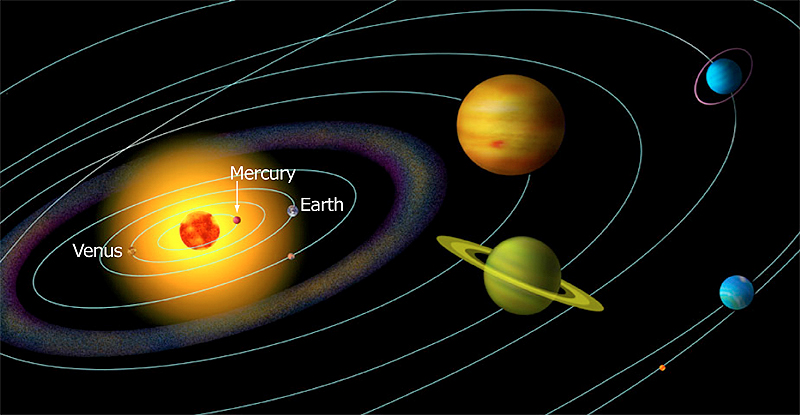
Or somewhat less obviously distorted like this:

Either of these images badly distorts the sizes of the planets, but they also badly distort the size of the sun. Even actual images of Mercury against the sun are hard to reconcile with real distances and sizes. This image makes it look like Mercury is very close to the sun (and oddly enough makes it look larger, relative to the sun than it actually is):
.jpg)
Try this image:

Those circles are orbits to scale, and the yellow dot in the center? That's the sun also to scale. The sun is huge but Mercury (black circle) orbits at a distance of 0.38 a.u., which is 41x the diameter of the sun--Venus is the gold circle, Earth blue and Mars red. Also, none of the planets are visible at this scale. The largest of this group, Earth, is .01 times the diameter of the sun, so if that sun were 100 pixels wide, Earth would be 1.
So as close as mercury is to the sun, it's still a fair distance (relative to the size of the sun), and the sun does not fill its sky (if you were on the surface of Mercury the sun would appear a bit less than 3x the diameter--9x the area--than it does here on Earth).
That last image isn't as nice to look at but our MASSIVE sun is still a tiny dot compared with the orbits of even the very close planets in our stellar system. The outer planets make these orbitals seem small, and our entire planetary system is a speck in the Milky Way which is less than a spec in the universe overall.
This is how we are often showed an image of the solar system:
Or somewhat less obviously distorted like this:
Either of these images badly distorts the sizes of the planets, but they also badly distort the size of the sun. Even actual images of Mercury against the sun are hard to reconcile with real distances and sizes. This image makes it look like Mercury is very close to the sun (and oddly enough makes it look larger, relative to the sun than it actually is):
Try this image:

Those circles are orbits to scale, and the yellow dot in the center? That's the sun also to scale. The sun is huge but Mercury (black circle) orbits at a distance of 0.38 a.u., which is 41x the diameter of the sun--Venus is the gold circle, Earth blue and Mars red. Also, none of the planets are visible at this scale. The largest of this group, Earth, is .01 times the diameter of the sun, so if that sun were 100 pixels wide, Earth would be 1.
So as close as mercury is to the sun, it's still a fair distance (relative to the size of the sun), and the sun does not fill its sky (if you were on the surface of Mercury the sun would appear a bit less than 3x the diameter--9x the area--than it does here on Earth).
That last image isn't as nice to look at but our MASSIVE sun is still a tiny dot compared with the orbits of even the very close planets in our stellar system. The outer planets make these orbitals seem small, and our entire planetary system is a speck in the Milky Way which is less than a spec in the universe overall.
Tuesday, April 14, 2015
Is There Really a Call For This?
I know that some people party all night long, but even in college, even when we had no restrictions (i.e. house party) things were mostly done by 3 am. Yes, there were occasional later nights, and yes, some people have schedules that make the wee hours of the morning a perfectly sensible time to have a beer, but is there really enough of a pool of patrons to have bars stay open until 4 am? Well, in a working/residential city anyway (not Vegas, not New Orleans)?
I know I'm old and all, but things just go downhill fast after 2 am. Also, nearby residents probably will hate it and stay off my lawn (don't really have to worry much in my inner burb hood).
I know I'm old and all, but things just go downhill fast after 2 am. Also, nearby residents probably will hate it and stay off my lawn (don't really have to worry much in my inner burb hood).
Thursday, March 26, 2015


Subscribe to:
Comments (Atom)