The government needs revenue. It must acquire that somehow. That somehow is taxes. What would be the most "fair" method to tax by? I have my opinion, but here is my overview...
1. Income taxes: taxes on all income.
2. Wage taxes: taxes only on income earned by working.
3. Consumption taxes: value added taxes (VAT) and sales taxes.
4. Corporate taxes: taxing business (profit).
5. Tariffs: taxes on import/export of trade goods.
6. Property taxes: taxing ownership of somethings.
7. Estate taxes: taxing transfer by deed.
Numbers 2 and 3 are inherently regressive taxes. The rest can be progressive, flat or regressive depending on how they are set up. In many states property taxes are flat. Income taxes are generally set up to be progressive. The Estate tax is very progressive (though becomming less meaningful every alteration). It's hard to gauge the exact nature of corporate taxes and tariffs, and it isn't going to get you a good answer to ask. Still my ranking of like to dislike...
1. Estate tax. This is a great tax, that shouldn't really bug conservatives (though it does). It lets someone who has worked hard to build up a fortune keep it. But once they die their mostly good for nothing offspring (see: Walton family) have to pay a pretty hefty tax on what they are deeded. Progressive, decent revenue source, truly does not hurt anyone (the farmer issue is b.s.).
2. I like income tax. A lot. I would particularly like income tax to treat capital gains as normal income rather than in the bizarre way that it does in the US. Easy to make progressive. Generally pretty fair: everyone gets taxed according to their means (well not really, at present low to mid-income people are overtaxed, but ideally--with a good progressive tax scheme--it could be that way). Mostly it produces a lot of money in a relatively simple fashion. It's still way too damned complex, but so long as we have an elected government that won't change.
3. Corporate taxes. This is the first one that I am a bit ambivalent about. I think that it is a good way to get to a lot of revenue, some of which would otherwise be tax sheltered by people who have enough money to do that. I also think that it can stifle growth some. This is a tax I think needs lots of work to be really good, but that it can be really good. As it is too many big companies pay too little, while many smaller companies end up paying too much.
4. Consumption taxes I'm pretty ok with. I think VAT would be best, but even a simple sales tax is not a bad thing. Particularly one that does not apply to certain necessities (like non-junk food). While it does hit poor people harder, exempting food is a good way to minimize that. Specifying food that does and doesn't count, and having lots of other goods producers lobbying to be considered a necessity complicates things. VAT helps somewhat by having more tax on higher margin items...also by burying the tax to most people, it becomes easier to raise by 0.1% points every now and again. Most people wouldn't even notice. Of course, that is also a reason not to like it. Note: gas taxes are a special consumption tax.
5. Tariffs, I see, as more an international, economic negotiation tool than one for generating revenue. It could be simply because that is really how we use them. Kind of neutral except I don't think that protectionist taxes are a particularly good idea as they can (and do) end up hurting export oriented domestic business.
6. I generally don't like property taxes. Odd, as they have a possibility of being progressive to an extent nothing else on this list does (cap gains income is easier to shelter even with an ideal progressive income tax scheme). An ideal property tax system probably would be the most progressive system we could have, but I don't see it as a remotely real possibility. In the mean time, I do feel like if I purchase something, it is mine. I don't mind a small amount of property taxes to fund certain infrastructure issues (power, sewer, trash, roads), but I am strongly opposed to their, in some places dominant, use to fund schools. The quality of public schools should not be tied to the value of the neighborhoods that surround them. It's possible that I would like these better if they were state levied and redistributed according to need.
7. I detest wage taxes. Working people pay wage taxes. Rich people living off of interest and dividends and other capital gains do not pay any wage tax. Federal wage taxes are even worse since they have a dollar cut off and therefore wage earners are taxed in a regressive style. PA's state "income" tax is in fact a wage tax. As are the city taxes around here. Working people have to pay more than trust fund babies. Not fair, and morally reprehensible.
Friday, July 30, 2010


Tuesday, July 27, 2010
Conventional Idiocy
The Democrats are likely to lose seats this election. They are also likely to retain control of both houses of Congress. After the elections we will probably hear plenty (if we watch/read the news) about how Republicans have won. But Republicans are not likely to win this election. They are very likely to lose by less than they did in the past couple.
The Senate is messed up, so I'll ignore that.
The US House of Representatives completely turns over every two years. That means that the House is a good gauge of who the American people want governing them (kind of, gerrymandered districts actually mean that the US is more Democratic than the House, but eh?). If Democrats hold the House in the fall then it is the Democrats who have "won" the election. It is Democrats who have the support of the American people.
No matter how many seats the GOP picks up in November, if it is not enough to give them the majority in the House then the American people will have said: "We want Democrats in control."
It is possible the House turns over. Unfortunately, even if it doesn't we are likely to hear about what a big night it will have been for the GOP. And next to no one will admit the truth: Americans prefer to be governed by the Majority holder of the US House of Representatives.
The Senate is messed up, so I'll ignore that.
The US House of Representatives completely turns over every two years. That means that the House is a good gauge of who the American people want governing them (kind of, gerrymandered districts actually mean that the US is more Democratic than the House, but eh?). If Democrats hold the House in the fall then it is the Democrats who have "won" the election. It is Democrats who have the support of the American people.
No matter how many seats the GOP picks up in November, if it is not enough to give them the majority in the House then the American people will have said: "We want Democrats in control."
It is possible the House turns over. Unfortunately, even if it doesn't we are likely to hear about what a big night it will have been for the GOP. And next to no one will admit the truth: Americans prefer to be governed by the Majority holder of the US House of Representatives.
Monday, July 26, 2010
Curiouser and Curiouser
There seem to be some trains of thought on a collision course on the political left right now.
Train 1 left Boston about 15 years back traveling at near light speed toward the center of the country. It passed that about two years back and has slowed a bit but but really isn't looking back at the carnage left behind.
Train 2 tends to meander aimlessly at something between 20 and -40 mph. Currently it resides somewhere left of center, maybe, but probably not.
Train 1 is run by the heads of the Democratic party. Clinton, ran it for a bit. Now it is the Obama administration. Same train though. Lots of the "liberal" bloggers used to criticize this train as not being useful and causing more harm than good and not representing the people. They got tickets these past few years, however, and despite the fact that the train hasn't really changed direction or really even slowed much, they tend now to label the people who continue to criticize as not helping out.
Train 2 isn't really run by anyone, which explains why it meanders and changes velocity. This train formerly held most of the liberal/progressive blogosphere. There are still a few on board. It does have lots of independents. People who just want a government that functions (whether big or small) and for it mostly to not interfere with their personal lives. There are no tea baggers on board.
These holdover progressives and "independents" are not exactly tickled with the present administration (and those that pay attention are near apoplectic with Congress) but are largely being told that this administration is as good as we can hope for right now and so we should help out and keep working to get more (and better) Democrats elected.
But why? So that a Republican "Health Care" bill can be hailed as a progressive victory? So that we can continue to pour resources into creating death in Afghanistan? So that our (and others') civil liberties can continue to be trampled on? If this is the best that we can get with Democrats controlling everything, then what's the point in helping them?
We are living in a time that requires serious people in office. We do not have them. Even our president, who seemed as though he would be, is not. He is either weak and ineffective or he is obsessed with stupid things like the news cycle and that odd notion of perception (as opposed to reality) just like every other politician. Either way, he isn't likely to get my vote right now. Even if he ends up running against Sarah Palin (the embodiment of "moran").
I'll vote case by case and person by person. My congress critter hasn't been winning me over recently (took down his online contact page). My Senator has lost in the primary so I'll likely throw the new guy a bone there.
It isn't that I think Republicans would be better. I think they would be significantly worse. I don't think that things will get better if Democrats are taught a lesson by my not voting for them. But things are not actually getting better now. I'm just nearing the point that I'm willing to toss in the towel and let the country go to hell. I don't think I can bring myself to care enough. If the people in this country show up to vote Republicans back in power then our nation will get exactly what it deserves. It is the fault of Democrats--chiefly the current administration--if that happens.
When the hopes and dreams of the people who voted for you get tossed aside so thoughtlessly, then you don't deserve the support of those people any more. Shame on this administration and this Congress. And shame on anyone who works to defend their foolishness.
Train 1 left Boston about 15 years back traveling at near light speed toward the center of the country. It passed that about two years back and has slowed a bit but but really isn't looking back at the carnage left behind.
Train 2 tends to meander aimlessly at something between 20 and -40 mph. Currently it resides somewhere left of center, maybe, but probably not.
Train 1 is run by the heads of the Democratic party. Clinton, ran it for a bit. Now it is the Obama administration. Same train though. Lots of the "liberal" bloggers used to criticize this train as not being useful and causing more harm than good and not representing the people. They got tickets these past few years, however, and despite the fact that the train hasn't really changed direction or really even slowed much, they tend now to label the people who continue to criticize as not helping out.
Train 2 isn't really run by anyone, which explains why it meanders and changes velocity. This train formerly held most of the liberal/progressive blogosphere. There are still a few on board. It does have lots of independents. People who just want a government that functions (whether big or small) and for it mostly to not interfere with their personal lives. There are no tea baggers on board.
These holdover progressives and "independents" are not exactly tickled with the present administration (and those that pay attention are near apoplectic with Congress) but are largely being told that this administration is as good as we can hope for right now and so we should help out and keep working to get more (and better) Democrats elected.
But why? So that a Republican "Health Care" bill can be hailed as a progressive victory? So that we can continue to pour resources into creating death in Afghanistan? So that our (and others') civil liberties can continue to be trampled on? If this is the best that we can get with Democrats controlling everything, then what's the point in helping them?
We are living in a time that requires serious people in office. We do not have them. Even our president, who seemed as though he would be, is not. He is either weak and ineffective or he is obsessed with stupid things like the news cycle and that odd notion of perception (as opposed to reality) just like every other politician. Either way, he isn't likely to get my vote right now. Even if he ends up running against Sarah Palin (the embodiment of "moran").
I'll vote case by case and person by person. My congress critter hasn't been winning me over recently (took down his online contact page). My Senator has lost in the primary so I'll likely throw the new guy a bone there.
It isn't that I think Republicans would be better. I think they would be significantly worse. I don't think that things will get better if Democrats are taught a lesson by my not voting for them. But things are not actually getting better now. I'm just nearing the point that I'm willing to toss in the towel and let the country go to hell. I don't think I can bring myself to care enough. If the people in this country show up to vote Republicans back in power then our nation will get exactly what it deserves. It is the fault of Democrats--chiefly the current administration--if that happens.
When the hopes and dreams of the people who voted for you get tossed aside so thoughtlessly, then you don't deserve the support of those people any more. Shame on this administration and this Congress. And shame on anyone who works to defend their foolishness.
Sunday, July 25, 2010
Depressing
UK slashing funding for science research. I wonder what all these science hating conservatives are going to do when China surpasses us in science research and development. I'm guessing start a war, but that's only because that's where the evidence points.
Ok, I want one...
Well, really I just want enough other people to want one, but I think that it will take a bit more than pure performance for any but the biggest gearheads. I think that, at some point, if they want to create mass appeal/desire, they should do this with something a bit sexier than a 1972 Datsun.
I kinda like the look, and I've always been keen on cars that don't look like much but that can blow your doors off, but I'm certainly odd in that regard. Most people want cars that look fast, even if they aren't so much.
I kinda like the look, and I've always been keen on cars that don't look like much but that can blow your doors off, but I'm certainly odd in that regard. Most people want cars that look fast, even if they aren't so much.
Sunday, July 18, 2010
Frustrating...
...not surprising, but frustrating never the less. Toyota/Tesla partnership is serious because they are going to make an Electric SUV!!
The single biggest problem with transportation efficiency in this country is the size and weight of the vehicles that travel our streets. A bus or a truck that transports goods mitigates the efficiency issue with quantity (though rail is still more efficient...for both). If we could get 1700 lb cars with modern engines we could be seeing 50-70 mpg. Do the same thing with electric and you can 1) reduce the weight further, and 2) make the total efficiency equation even better.
The fact that people in this country still demand SUV's is very frustrating to me. I would love to see a vehicle weight tax. $2/lb over, say 3000 lbs. There is no good reason to have a vehicle that weighs more for 99.9% of this country. Not one.
The single biggest problem with transportation efficiency in this country is the size and weight of the vehicles that travel our streets. A bus or a truck that transports goods mitigates the efficiency issue with quantity (though rail is still more efficient...for both). If we could get 1700 lb cars with modern engines we could be seeing 50-70 mpg. Do the same thing with electric and you can 1) reduce the weight further, and 2) make the total efficiency equation even better.
The fact that people in this country still demand SUV's is very frustrating to me. I would love to see a vehicle weight tax. $2/lb over, say 3000 lbs. There is no good reason to have a vehicle that weighs more for 99.9% of this country. Not one.
Wednesday, July 14, 2010
When Winners Sulk
The losers win. This piece by Digby is an astoundingly good description of the way most of us Americans perceive winning and what that means.
The Democrats won big in 2006 and bigger in 2008. Victories giving them control of both houses of congress (and super large majorities in both) as well as the presidency. Any and all failures to accomplish things are theirs. Not Republicans. No matter how much it is the truth that bizzare rules and reprehensible behavior among the opposition is, in fact, to blame for the lack of accomplishment, that is not the way we collectively perceive things.
Democrats have control of pretty much everything (and to a much greater extent than Republicans ever have) and have accomplished next to nothing. Republicans are clearly winning, and Democrats are clearly useless, and in a country that values winning over losing more than it does right over wrong, votes are likely to go to the winners, i.e. Republicans.
Along those lines, any time I read (or hear) some "liberal" pundit crow about how the health care--actually health insurance--legislation as some major accomplishment I want to claw my eyes (or ears) out. That any Democrat would want to claim that the Republican legislation which passed was a win is not just a shame, it's a concession that only Republicans can win. Even when they all oppose and fight against it, Republicans still got their legislation passed. Democrats are pathetic losers, even when they "win".
The Democrats won big in 2006 and bigger in 2008. Victories giving them control of both houses of congress (and super large majorities in both) as well as the presidency. Any and all failures to accomplish things are theirs. Not Republicans. No matter how much it is the truth that bizzare rules and reprehensible behavior among the opposition is, in fact, to blame for the lack of accomplishment, that is not the way we collectively perceive things.
Democrats have control of pretty much everything (and to a much greater extent than Republicans ever have) and have accomplished next to nothing. Republicans are clearly winning, and Democrats are clearly useless, and in a country that values winning over losing more than it does right over wrong, votes are likely to go to the winners, i.e. Republicans.
Along those lines, any time I read (or hear) some "liberal" pundit crow about how the health care--actually health insurance--legislation as some major accomplishment I want to claw my eyes (or ears) out. That any Democrat would want to claim that the Republican legislation which passed was a win is not just a shame, it's a concession that only Republicans can win. Even when they all oppose and fight against it, Republicans still got their legislation passed. Democrats are pathetic losers, even when they "win".
Thursday, July 08, 2010
Credit Unions
I like credit unions (not for profit financial institutions). They tend to have less troublesome--i.e. evil--practices. The benefits of being not for profit are: no taxes, better rates (deposit and lending).
It's pretty easy to figure. Imagine a bank and a credit union with the same depositor base. Both set a rate for a new car loan for a specific person at 6.25%. Both institutions have employees to pay, and insurance to buy, and other expenses (building, electronic transactions, etc.). To simplify let's just say that those expenses are the same for both, which is reasonable since we are trying to compare to similar sized institutions. Exactly what that will take away is hard to say, but as it doesn't really matter, let's say the leftovers on the loan is 2.5%. With a credit union all of that will go to the depositors as interest. The goal of the bank, however, is profit.
So for the bank, some of those leftovers are going to be profit. Since a bank is for profit, those profits are taxed, so those taxes also come out of that extra (technically they come out of the profits, but the profits are set greater to accommodate the tax burden). If depositors at a bank are lucky, then they get about a quarter to the dollar of a good credit union.
Now credit unions can also lower lending rates, which would reduce deposit interest, but would benefit customers in a different way. The result is the same: banks absolutely, positively, cannot compete in a rational market.
So banks try and make the market as irrational as possible. Laws are written so that credit union charters are granted very narrowly so that credit unions cannot grow or spread too much. Credit unions are made to have restrictions on who can join. Credit unions are not allowed access to the fed for their money but must often go to banks for their short term loans.
As such I love to see banks fail when going up against credit unions. More, I can't stand the dumb ass tax argument. Credit unions are tax free because of their not for profit status, not because banks have been relatively successful--to date--in pinning them to small isolated customer bases. So long as a credit union remains not for profit, they will retain their tax free status and should be allowed to grow as large as the market will bear. Right?
It's pretty easy to figure. Imagine a bank and a credit union with the same depositor base. Both set a rate for a new car loan for a specific person at 6.25%. Both institutions have employees to pay, and insurance to buy, and other expenses (building, electronic transactions, etc.). To simplify let's just say that those expenses are the same for both, which is reasonable since we are trying to compare to similar sized institutions. Exactly what that will take away is hard to say, but as it doesn't really matter, let's say the leftovers on the loan is 2.5%. With a credit union all of that will go to the depositors as interest. The goal of the bank, however, is profit.
So for the bank, some of those leftovers are going to be profit. Since a bank is for profit, those profits are taxed, so those taxes also come out of that extra (technically they come out of the profits, but the profits are set greater to accommodate the tax burden). If depositors at a bank are lucky, then they get about a quarter to the dollar of a good credit union.
Now credit unions can also lower lending rates, which would reduce deposit interest, but would benefit customers in a different way. The result is the same: banks absolutely, positively, cannot compete in a rational market.
So banks try and make the market as irrational as possible. Laws are written so that credit union charters are granted very narrowly so that credit unions cannot grow or spread too much. Credit unions are made to have restrictions on who can join. Credit unions are not allowed access to the fed for their money but must often go to banks for their short term loans.
As such I love to see banks fail when going up against credit unions. More, I can't stand the dumb ass tax argument. Credit unions are tax free because of their not for profit status, not because banks have been relatively successful--to date--in pinning them to small isolated customer bases. So long as a credit union remains not for profit, they will retain their tax free status and should be allowed to grow as large as the market will bear. Right?
Saturday, July 03, 2010
Functional Banks
Banking serves an important role in the economy: it distributes money efficiently (when it works). People who have extra money put it into a bank, and that bank loans it out to others who need money (for things like cars, houses, ginormous tv's...). People who borrow money pay interest and the people who deposit (lend) money receive some portion of that interest. The difference goes to the bank, which uses it to pay employees, maintain infrastructure, et cetera.
When working well there isn't much extra past that because if there were, then some other bank would pay better rates to depositors and depositors would take their money and put it there. Banking should not be a very profitable industry, and it isn't. That's where investment banking comes in.
Investment banking supposedly does something similar (for our economy) to what regular banks do, but borrowers (and "depositors") are bigger and sometimes so are their risks. Investment banks sell securities to investors. Those securities are essentially loans to others. Investment banks are serving as intermediaries (like regular banks) but with no risk. If a loan (security) fails to pay out or plummets in value, it is the investor that is out the money. Investment banks do not make money off interest, but rather fees.
If a loan fails, the bank is out $, which motivates it to determine that the borrower is not likely to run out and that the collateral is sound.
For an investment bank, there is no such motivation. There is, however, a duty to give accurate and complete information to their clients (investors). But the motivation is to make that information as complicated and difficult to understand as possible so that they can sell any investment (good, bad, or otherwise), and so that they can hide true costs and pocket larger fees through the sales.
Pretty much all of the failures that occurred with respect to the financial crisis are due to investment banking. It is true that conventional banks were part of that, but that was simply a function of this murky securities market, and the wall separating the two (part of Glass-Steagall) being eliminated.
Since Glass-Steagall is not being restored, I fully expect this to repeat itself.
When working well there isn't much extra past that because if there were, then some other bank would pay better rates to depositors and depositors would take their money and put it there. Banking should not be a very profitable industry, and it isn't. That's where investment banking comes in.
Investment banking supposedly does something similar (for our economy) to what regular banks do, but borrowers (and "depositors") are bigger and sometimes so are their risks. Investment banks sell securities to investors. Those securities are essentially loans to others. Investment banks are serving as intermediaries (like regular banks) but with no risk. If a loan (security) fails to pay out or plummets in value, it is the investor that is out the money. Investment banks do not make money off interest, but rather fees.
If a loan fails, the bank is out $, which motivates it to determine that the borrower is not likely to run out and that the collateral is sound.
For an investment bank, there is no such motivation. There is, however, a duty to give accurate and complete information to their clients (investors). But the motivation is to make that information as complicated and difficult to understand as possible so that they can sell any investment (good, bad, or otherwise), and so that they can hide true costs and pocket larger fees through the sales.
Pretty much all of the failures that occurred with respect to the financial crisis are due to investment banking. It is true that conventional banks were part of that, but that was simply a function of this murky securities market, and the wall separating the two (part of Glass-Steagall) being eliminated.
Since Glass-Steagall is not being restored, I fully expect this to repeat itself.
Thursday, June 24, 2010
Lion Burgers...Seriously.
I was reading Tea and Food where I followed a link to this nugget: "US Restaurant to Serve World Cup Lion Burgers." This is not a marketing gimmick (well, it is, but...) but actual lion meat ground up (with some beef), cooked, and served on a bun.
I find this decision by the restaurant a bit odd, due to the response which should have been obvious (bomb threat not withstanding), but I don't have a personal problem with it. My feelings are pretty well summed up by (Tea and Food blogger) Aaron Kagan:
Still I really liked (Tea and Food writer) Aaron's friend's explanation about why he thinks this is horrible. It's wordy, and I only post long posts when the words are mine, so go read the whole thing but the gist is:
I find this decision by the restaurant a bit odd, due to the response which should have been obvious (bomb threat not withstanding), but I don't have a personal problem with it. My feelings are pretty well summed up by (Tea and Food blogger) Aaron Kagan:
If you're not opposed to eating animals in general, why is this so bad? If they're raised (and presumably slaughtered) humanely and are bred in captivity and not removed from the ecosystem that depends on them, why is eating a lion worse than eating a cow? Is it a matter of intelligence of the animal? If so, it may be that pigs are smarter than lions, but it doesn't make news when we eat them.
Still I really liked (Tea and Food writer) Aaron's friend's explanation about why he thinks this is horrible. It's wordy, and I only post long posts when the words are mine, so go read the whole thing but the gist is:
The fact that a lion could tear me to shreds in a fight - it not only instills me with a sense of fear but a sense of deep respect. The idea of raising these beautiful and mysterious creatures to kill and eat in a commonplace burger feels on a visceral level like cheating. It's cheating nature. It's cheating life. It's ruining the mystery.
Tuesday, June 01, 2010
College Debt
I just finished reading this story about just plain stupid college debt.
I think the government should fully fund education through to BA/BS, with some requirement for a year or two of community service that could be accomplished in many ways. Graduate degrees could be funded with some additional service requirement: 5 yrs rural/at need practice for an MD/JD, teaching or some additional service for other graduate degrees. The catch is that this would only apply to state schools.
The woman in the story went to NYU. I lost most of my sympathy right there. I have very little pity for people who chose exorbitantly priced private universities in general, less if they finance through debt, and then get in trouble. I agree with the author that schools, like NYU, should help to keep their students out of this kind of trouble, but, really, NYU is priced for children of millionaires, with some token poorer students on a full ride to mix things up. Families in the middle are really quite screwed.
Hence public universities. They've gone up a whole bunch in cost as well the past couple decades, but a year at SUNY [city] is going to be half the cost or less of one at NYU. Because debt tends to finance the last bit, there is a good chance that half the cost would translate to a quarter or less of the debt.
There is also the complaint that she got this astounding debt while earning a religious and women's studies degree, which doesn't have the same earning potential as an engineering or science degree. That doesn't bother me too much as I don't think we should have differential pricing (or creditworthiness) based on major, and I do think that majors with lower earning potential are still valuable. Of course I also think we should pay teachers $100k/year and that banksters should have earnings well below that. So while it may be nice to live in my fantasy world it isn't real life.
In the real world some majors earn more than others. More importantly, some families can afford more than others. Higher education pricing is exacerbating that gap rather than reducing it. Making it easier to wipe out student loan debt may help. So too would limiting payments as a fraction of income. But any solution I would like would only apply to debt acquired at a public institution. It's all and good if some over proud high school student and his/her parents get all excited about Harvard, but hell if I think tax dollars should accommodate that education.
I think the government should fully fund education through to BA/BS, with some requirement for a year or two of community service that could be accomplished in many ways. Graduate degrees could be funded with some additional service requirement: 5 yrs rural/at need practice for an MD/JD, teaching or some additional service for other graduate degrees. The catch is that this would only apply to state schools.
The woman in the story went to NYU. I lost most of my sympathy right there. I have very little pity for people who chose exorbitantly priced private universities in general, less if they finance through debt, and then get in trouble. I agree with the author that schools, like NYU, should help to keep their students out of this kind of trouble, but, really, NYU is priced for children of millionaires, with some token poorer students on a full ride to mix things up. Families in the middle are really quite screwed.
Hence public universities. They've gone up a whole bunch in cost as well the past couple decades, but a year at SUNY [city] is going to be half the cost or less of one at NYU. Because debt tends to finance the last bit, there is a good chance that half the cost would translate to a quarter or less of the debt.
There is also the complaint that she got this astounding debt while earning a religious and women's studies degree, which doesn't have the same earning potential as an engineering or science degree. That doesn't bother me too much as I don't think we should have differential pricing (or creditworthiness) based on major, and I do think that majors with lower earning potential are still valuable. Of course I also think we should pay teachers $100k/year and that banksters should have earnings well below that. So while it may be nice to live in my fantasy world it isn't real life.
In the real world some majors earn more than others. More importantly, some families can afford more than others. Higher education pricing is exacerbating that gap rather than reducing it. Making it easier to wipe out student loan debt may help. So too would limiting payments as a fraction of income. But any solution I would like would only apply to debt acquired at a public institution. It's all and good if some over proud high school student and his/her parents get all excited about Harvard, but hell if I think tax dollars should accommodate that education.
Thursday, May 27, 2010
"Some Dreams Are Bad Dreams"
After hearing a very poor graduation speech Wednesday, I read a very good one today. Two big messages:
"Some dreams are bad dreams."
Do not live each day as though it is your last.
The two things do go together. Lots of personal triumphs are the realization of dreams that hurt other people (financially, emotionally, or physically). Actions have consequences. If this is your last day then they don't. It may be worth turning that around and asking people to live as if each day was the last for another person, but probably not. It's a good speech. Go. Read.
"Some dreams are bad dreams."
Do not live each day as though it is your last.
The two things do go together. Lots of personal triumphs are the realization of dreams that hurt other people (financially, emotionally, or physically). Actions have consequences. If this is your last day then they don't. It may be worth turning that around and asking people to live as if each day was the last for another person, but probably not. It's a good speech. Go. Read.
Tuesday, May 25, 2010
Frustrating Conversations

In speaking with someone regarding the AZ law I had mentioned that the sheriff from the Tuscon area (Pima county) has, as part of his jurisdiction, a decent stretch of the Mexico-US border, and that he opposes the new law. At the same time the Phoenix area Sheriff (Maricopa county) who supports the law is a ways in from the border. I was told that I was wrong and was ranted at for having an opinion but not even knowing the geography. The geography, by the way, is shown above. How wrong was I? A little. I would have place Phoenix closer to Flagstaff, and the edge of Maricopa county is only ~40 miles from the boarder at closest approach even though Phoenix is more like 130 miles.
I recognize that illegal immigration is not confined to the border, but the border is the point of conflict. That is the line that drug smugglers are trying to get across. That is where security forces will be working. That is where the rancher was killed (maybe by an illegal immigrant). I recognize that Tuscon is super liberal and all, but I'm pretty sure that their sheriff wants low crime, not high, and that he is far more likely to have to deal with boarder related crime, and that his opinion on the matter, therefore, holds a bit more sway to me. I'll grant that if it were the other way around I would likely make a different argument (something along the lines of how the Maricopa sheriff seems to strive for attention like Sarah Palin, and that he doesn't seem to care so much about solving the problem as bitching about it), but I digress.
I didn't know the AZ geography perfectly, but I had it right so far as the point I was making goes. Criticism leveled against what I had wrong is more an indication that the counter position is weak, or that the person who is posing it cannot adequately express its strengths.
Also, for the record, I think that Bush's push for immigration reform was good. It was one of the very small number of things that I agreed with him on (and strongly agreed at that). It was not derailed by Democrats, but by Republicans like Tancredo.
Monday, May 17, 2010
Sentence Failure
In the effort to condense complex ideas and thoughts into something for this blog I (often) end up with impossible to decipher sentences. There were a few in the gender discrimination article. Mostly what I wanted to say is that the pay gap is a symptom of gender discrimination, but not in a "evil sexist companies" way.
Evidence to my perspective popped up on CNN today in this article on women making more money than their (male) spouses. Until that article is not newsworthy, or even odd seeming to many people, there will be a pay gap. That has less to do with evil sexist hiring/salary practices and more to do with the way that we perceive roles for men and women as a society. That the article is news is still a problem, but what it says indicates that things are getting better.
This perception issue resonates across all gender issues (including the violent/angry sexism which is still around).
Evidence to my perspective popped up on CNN today in this article on women making more money than their (male) spouses. Until that article is not newsworthy, or even odd seeming to many people, there will be a pay gap. That has less to do with evil sexist hiring/salary practices and more to do with the way that we perceive roles for men and women as a society. That the article is news is still a problem, but what it says indicates that things are getting better.
This perception issue resonates across all gender issues (including the violent/angry sexism which is still around).
Thursday, May 13, 2010
Vitamin D
The main reason anyone doesn't get enough is because we (collectively) spend too much time not outside. On top of that we tend to slather on loads of sunscreen when we do go out meaning that we don't get our Vitamin D even then. Now this study saying infants are Vitamin D deprived, especially breast fed infants.
That breast fed infants are not getting enough Vitamin D should tell people that we are insanely over paranoid about going outside and the possibility of getting burned. Not that we should have to give an infant a dietary supplement. I know that there are dangers of overexposure to UV and that it is worse than it was 1000 years ago, but it is also overblown. If you are sensible about going outside--don't be outside in the sun from 12-3 unless you have to and then keep covered first use sunscreen second, don't wait until mid summer and 90 degree weather to get sun, if you skin starts to feel warm get in or under cover, ...--then there shouldn't be a problem.
It only takes 15 minutes of exposure to get your Vitamin D. Supplementing this is insanity, not good practice.
That breast fed infants are not getting enough Vitamin D should tell people that we are insanely over paranoid about going outside and the possibility of getting burned. Not that we should have to give an infant a dietary supplement. I know that there are dangers of overexposure to UV and that it is worse than it was 1000 years ago, but it is also overblown. If you are sensible about going outside--don't be outside in the sun from 12-3 unless you have to and then keep covered first use sunscreen second, don't wait until mid summer and 90 degree weather to get sun, if you skin starts to feel warm get in or under cover, ...--then there shouldn't be a problem.
It only takes 15 minutes of exposure to get your Vitamin D. Supplementing this is insanity, not good practice.
Thursday, May 06, 2010
Hornet's Nest Being Kicked
When it comes to the gender pay gap, I'm very conflicted, mostly because I'm male.
First off, according to the linked report there are "legitimate" things that cover a good portion of the difference (80%). The remainder, the authors say, can be reasonably contributed to gender discrimination. Seeing as the resulting gender pay difference is only 5% one year out of college (women make 95% of what men make in the same professions), I'll buy that.
I will, unfortunately, follow that with: it isn't really possible to control for everything: imagine two companies that do the same thing, but one pays employees 20% more and is 90% male while the other pays less and is 50% male. Even if size and all other perks are the same, the former company is male dominated and might have a harder time attracting and keeping women (even if they were to favorably hire them). Of course, this is still gender discrimination, as the other company is effectively taking advantage of the fact that they can get top tier women at 80% the price by having more of them to start out with. This is still a problem.
I suppose what I never feel is well addressed is the question "What does 'gender discrimination' mean specifically?" The authors don't really answer that question effectively and that means their solutions to closing the pay gap end up short. So while many of their solutions make sense and are good, some, however, seem based on their own acceptance of societal gender discrimination.
Particularly when it comes to a few issues. So long as child care is perceived as benefiting women's employment it is likely to hurt their paychecks with respect to men's. Same with family leave. Same with using hours as the primary measure of productivity. Simply proposing these things as solutions is conceding that women can't achieve the same pay level without these aids which men don't need that cost companies money. I don't believe that.
I don't expect to be paid as much if I don't work as many hours as someone else. I don't expect to be paid as much if I require more time off per year for family or medical emergencies. I wouldn't expect to be paid as much if I have a child and make (use of) the company provided day care.
But those are all related to societal gender discrimination, not workplace. We happen to live in a society that believes men are more valuable in the workplace in part because it believes men are less valuable at home and as parents.
It is very likely that workplace gender discrimination is still prevalent (particularly going back in time) but so long as it is socially ingrained it won't go away. Things that force the issue do--rightly or wrongly--make men angry. If we can reach a point where men see things like day care at work and family leave as being of great benefit to them, and if we can reach a point where a man who is a stay-at-home dad taking care of the house and kids is not thought of as "unmanly" and if we can reach a point where a woman who works is not considered a horrible mother and if we can reach a point that a woman who marries down the economic ladder does not seem odd, then we will be able to have gender pay equity.
It is possible, of course, that forcing pay equity through pro female gender discrimination is an effective and good method to doing this. But pretending that those solutions are somehow fair in a world that they are required only to produce fairness for women, and not that they are a different form of gender discrimination required because of the gender discrimination that is societal is just dishonest.
First off, according to the linked report there are "legitimate" things that cover a good portion of the difference (80%). The remainder, the authors say, can be reasonably contributed to gender discrimination. Seeing as the resulting gender pay difference is only 5% one year out of college (women make 95% of what men make in the same professions), I'll buy that.
I will, unfortunately, follow that with: it isn't really possible to control for everything: imagine two companies that do the same thing, but one pays employees 20% more and is 90% male while the other pays less and is 50% male. Even if size and all other perks are the same, the former company is male dominated and might have a harder time attracting and keeping women (even if they were to favorably hire them). Of course, this is still gender discrimination, as the other company is effectively taking advantage of the fact that they can get top tier women at 80% the price by having more of them to start out with. This is still a problem.
I suppose what I never feel is well addressed is the question "What does 'gender discrimination' mean specifically?" The authors don't really answer that question effectively and that means their solutions to closing the pay gap end up short. So while many of their solutions make sense and are good, some, however, seem based on their own acceptance of societal gender discrimination.
Particularly when it comes to a few issues. So long as child care is perceived as benefiting women's employment it is likely to hurt their paychecks with respect to men's. Same with family leave. Same with using hours as the primary measure of productivity. Simply proposing these things as solutions is conceding that women can't achieve the same pay level without these aids which men don't need that cost companies money. I don't believe that.
I don't expect to be paid as much if I don't work as many hours as someone else. I don't expect to be paid as much if I require more time off per year for family or medical emergencies. I wouldn't expect to be paid as much if I have a child and make (use of) the company provided day care.
But those are all related to societal gender discrimination, not workplace. We happen to live in a society that believes men are more valuable in the workplace in part because it believes men are less valuable at home and as parents.
It is very likely that workplace gender discrimination is still prevalent (particularly going back in time) but so long as it is socially ingrained it won't go away. Things that force the issue do--rightly or wrongly--make men angry. If we can reach a point where men see things like day care at work and family leave as being of great benefit to them, and if we can reach a point where a man who is a stay-at-home dad taking care of the house and kids is not thought of as "unmanly" and if we can reach a point where a woman who works is not considered a horrible mother and if we can reach a point that a woman who marries down the economic ladder does not seem odd, then we will be able to have gender pay equity.
It is possible, of course, that forcing pay equity through pro female gender discrimination is an effective and good method to doing this. But pretending that those solutions are somehow fair in a world that they are required only to produce fairness for women, and not that they are a different form of gender discrimination required because of the gender discrimination that is societal is just dishonest.
Wednesday, May 05, 2010
Housing and Inflation
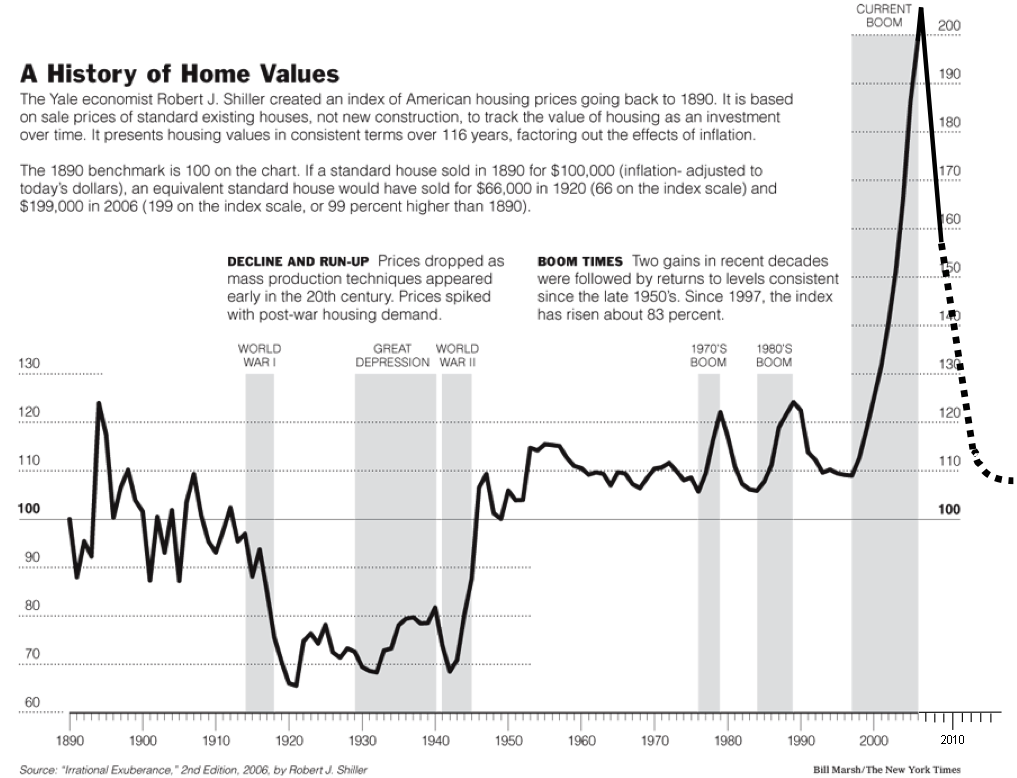
Been playing with this.
I don't generally believe that thinking of a house as an investment is the right way to think. I mean, it is one, but it's not really a good one. When house prices are not being boosted by bankers gone wild they only grow at the same rate as wages (which is approximately that of inflation...most of the time). But what they really do is hedge your monthly living expenses against inflation.
If I buy a house now on a 30 year mortgage, my "rent" will stay static for 30 years then drop precipitously. Taxes are likely to change, so that isn't completely right, but that change is small compared to rents. Rents, like houses, tend to inflate with wages, but unlike houses, rents are locked in a year at a time. So next year, rent goes up, my mortgage doesn't. Same the year after and the year after that.
If I can have a mortgage payment that is only a little more than an equivalent rent (my mortgage is about the same or a little less than an equivalent rent) then I start gaining on the up front costs of purchasing after a few years. This is true whether or not the "value" of my house is increasing at a similar rate, or at all, and maybe even if it is falling.
People who plan on moving every 2-5 years don't necessarily get this benefit since the upfront costs to purchase takes a few years to wipe out and in the present economy will likely take a bit longer than normal.
To me this is one of the most important reasons to purchase. I like reading Patrick.net, but many of the rent vs own arguments I see there relate to immediate financials and not long term. If I can purchase a place at $2k/mo (mortgage + taxes + pmi/other) and rent the exact same place for $1700/mo it may look like renting is better (especially when factoring in closing costs), but that only holds for the short term.
This argument, of course, falls flat if we face deflation rather than inflation. So it is still a gamble, but even if you only listen to inflation skeptics (those that don't think we are likely to see high inflation starting in a year to a few years) you won't find many people arguing that we are likely to see much deflation, and that what we do see won't last. In fact many of the same people who have been arguing against buying houses (prices still need to come down!) also argue for buying gold! When it comes to a good hedge against inflation, historically, stocks do better than gold. Investments, however, are with extra money (what you don't need to live on) a is a way to use your monthly shelter payment (rent) as an additional hedge against inflation, and also maybe even as an investment (albeit a weak one).
I don't generally believe that thinking of a house as an investment is the right way to think. I mean, it is one, but it's not really a good one. When house prices are not being boosted by bankers gone wild they only grow at the same rate as wages (which is approximately that of inflation...most of the time). But what they really do is hedge your monthly living expenses against inflation.
If I buy a house now on a 30 year mortgage, my "rent" will stay static for 30 years then drop precipitously. Taxes are likely to change, so that isn't completely right, but that change is small compared to rents. Rents, like houses, tend to inflate with wages, but unlike houses, rents are locked in a year at a time. So next year, rent goes up, my mortgage doesn't. Same the year after and the year after that.
If I can have a mortgage payment that is only a little more than an equivalent rent (my mortgage is about the same or a little less than an equivalent rent) then I start gaining on the up front costs of purchasing after a few years. This is true whether or not the "value" of my house is increasing at a similar rate, or at all, and maybe even if it is falling.
People who plan on moving every 2-5 years don't necessarily get this benefit since the upfront costs to purchase takes a few years to wipe out and in the present economy will likely take a bit longer than normal.
To me this is one of the most important reasons to purchase. I like reading Patrick.net, but many of the rent vs own arguments I see there relate to immediate financials and not long term. If I can purchase a place at $2k/mo (mortgage + taxes + pmi/other) and rent the exact same place for $1700/mo it may look like renting is better (especially when factoring in closing costs), but that only holds for the short term.
This argument, of course, falls flat if we face deflation rather than inflation. So it is still a gamble, but even if you only listen to inflation skeptics (those that don't think we are likely to see high inflation starting in a year to a few years) you won't find many people arguing that we are likely to see much deflation, and that what we do see won't last. In fact many of the same people who have been arguing against buying houses (prices still need to come down!) also argue for buying gold! When it comes to a good hedge against inflation, historically, stocks do better than gold. Investments, however, are with extra money (what you don't need to live on) a is a way to use your monthly shelter payment (rent) as an additional hedge against inflation, and also maybe even as an investment (albeit a weak one).
This argument also falls flat if you buy a house at the wrong time and place, like, say 4 years ago in California. People who bought at the peak of the market may never recover their investment. Of course, people buying then were having to pay much more than what the equivalent rent would be.
Sunday, April 25, 2010
The Theme Is: Education
I quickly glanced down a list of jobs paying $30-$40/hr and one thing was very clear: you need an education to get them.
Just a quick note, full time at $30/hr is ~$60k/yr. What isn't clear is how the hourly rate is figured. Does the $30/hr that a kindergarten teacher make only count the hours that they have students in class? That doesn't necessarily translate to how much they actually work, and it does leave out the gaping hole in their income that results from nearly four months unpaid. Does "post secondary" mean professor or just lecturer, and if the latter, does that only count the 8-20 hrs/week that they actually spend in a classroom and holding office hours?
Still, the message is clear if already well known: you are better off with a college degree.
Just a quick note, full time at $30/hr is ~$60k/yr. What isn't clear is how the hourly rate is figured. Does the $30/hr that a kindergarten teacher make only count the hours that they have students in class? That doesn't necessarily translate to how much they actually work, and it does leave out the gaping hole in their income that results from nearly four months unpaid. Does "post secondary" mean professor or just lecturer, and if the latter, does that only count the 8-20 hrs/week that they actually spend in a classroom and holding office hours?
Still, the message is clear if already well known: you are better off with a college degree.
Thursday, April 22, 2010
Green is Cheap
I really don't think this message penetrates very well. I think mostly because of the very, very intense marketing we experience in this country. If you want to live "green" then: stop buying shit! Yes, also, don't live in a huge home. Don't fertilize the hell out of your yard. Don't leave your house lit up like Christmas every night. Keep the thermostat below 70 (or even better: 65) in the winter and above 75 (or even 80) in the summer. Don't take baths, and take fast showers.
But really, it is buying shit (particularly disposable shit but really pretty much anything) that is the problem. It has to be made, it has to be transported, it has to be disposed of. All of those things contribute carbon. That is true of food, furniture, toilet paper, baby wipes, every damned thing.
Of course, if people listened to that it would put an even bigger hurt on our economy, and frankly, most Americans don't really want to live "green" lifestyles as they kind of suck... I mean the nations with the lowest carbon footprints (per capita) tend to be among the world's poorest. Americans with the lowest carbon footprint also tend to be very poor (homeless, carless, and living in an urban setting).
No matter how "green" I become, I am responsible for a hell of a lot more carbon than an impoverished Bangladeshi. That would be true even if I were better than 95% of Americans (I'm not). Of course I'm orders of magnitude better than our nation's millionaires and billionaires.
But really, it is buying shit (particularly disposable shit but really pretty much anything) that is the problem. It has to be made, it has to be transported, it has to be disposed of. All of those things contribute carbon. That is true of food, furniture, toilet paper, baby wipes, every damned thing.
Of course, if people listened to that it would put an even bigger hurt on our economy, and frankly, most Americans don't really want to live "green" lifestyles as they kind of suck... I mean the nations with the lowest carbon footprints (per capita) tend to be among the world's poorest. Americans with the lowest carbon footprint also tend to be very poor (homeless, carless, and living in an urban setting).
No matter how "green" I become, I am responsible for a hell of a lot more carbon than an impoverished Bangladeshi. That would be true even if I were better than 95% of Americans (I'm not). Of course I'm orders of magnitude better than our nation's millionaires and billionaires.
Wednesday, April 21, 2010
Ok, So the Fix Is?
After bitching about Jamie Oliver, and reading Marc Ambinder's article on obesity, I figured that I should propose something that accomplishes what Jamie seems to be trying but that would actually work.
The obesity epidemic is huge, and the causes are varied and large themselves, as Marc very effectively points out. The solution, unfortunately, must be equal to it. As much as I dislike Marc's quick postulation about surgery for all, it--unlike Jamie's posturing--is a proposal that could really work. I don't like it though. Here are some other (maybe less unlikely to occur) things that together would do wonders:
1. End farm subsidies (at least increase subsidies for healthier farm products to match corn).
2. Tax soda (heavily) and pretty much any snack food and convenience food (chips, cookies, frozen pizza, dear God Hot Pockets!). More simply: tax anything that isn't produce (fresh, dried frozen or canned), or good grain products (whole grain breads, pasta, rice). Meat can be tax free as the ended subsidies will likely increase it's cost substantially. Really though, taxing soda and candy is a must.
3. Gas tax (min $2/gallon). People will drive less. This may also mean they will walk more. Also transportation costs will go up and so will the price of food shipped from further away, particularly for multi-shipped food (grain to mil, mill to cow, cow to slaughter/butcher, butcher to grocers). Many transport issues are actually not too bad other than the last one or two, but still...
4. Subsidize: public transit, biking lanes/trails, walking oriented development and growth.
There are two things making us fat: our diet and our activity level. We can't force people to exercise (or not eat cake) but we can make better eating cheaper and crappy eating more expensive, and we can make it easier for people to walk or bicycle, as opposed to driving. These things take a great deal of political will to happen, however, one that seems lacking today.
The obesity epidemic is huge, and the causes are varied and large themselves, as Marc very effectively points out. The solution, unfortunately, must be equal to it. As much as I dislike Marc's quick postulation about surgery for all, it--unlike Jamie's posturing--is a proposal that could really work. I don't like it though. Here are some other (maybe less unlikely to occur) things that together would do wonders:
1. End farm subsidies (at least increase subsidies for healthier farm products to match corn).
2. Tax soda (heavily) and pretty much any snack food and convenience food (chips, cookies, frozen pizza, dear God Hot Pockets!). More simply: tax anything that isn't produce (fresh, dried frozen or canned), or good grain products (whole grain breads, pasta, rice). Meat can be tax free as the ended subsidies will likely increase it's cost substantially. Really though, taxing soda and candy is a must.
3. Gas tax (min $2/gallon). People will drive less. This may also mean they will walk more. Also transportation costs will go up and so will the price of food shipped from further away, particularly for multi-shipped food (grain to mil, mill to cow, cow to slaughter/butcher, butcher to grocers). Many transport issues are actually not too bad other than the last one or two, but still...
4. Subsidize: public transit, biking lanes/trails, walking oriented development and growth.
There are two things making us fat: our diet and our activity level. We can't force people to exercise (or not eat cake) but we can make better eating cheaper and crappy eating more expensive, and we can make it easier for people to walk or bicycle, as opposed to driving. These things take a great deal of political will to happen, however, one that seems lacking today.
Subscribe to:
Posts (Atom)